IMS4Maths Achieves 1.45M Impressions, 131K Clicks & 394% Top-10 Keyword Growth in 12 Months
How an AI-Ready Search Strategy Turned Visibility into Consistent Student Enquiries
MgiWebzone rebuilt IMS4Maths’ digital growth system to align with how UPSC aspirants search and decide today—across Google results, AI Overviews, question-based queries, and comparison-driven discovery.
By improving website structure, content clarity, authority signals, and enquiry journeys, IMS4Maths achieved 1.45M organic impressions, 131K clicks, and strong Top-10 keyword growth. This ensured serious Maths Optional aspirants consistently discovered the institute at the right decision stage, turning search visibility into steady, high-intent student enquiries instead of random traffic.
Why IMS4Maths Needed a Modern Digital Growth Strategy
Key Objectives
- Establish clear organic domain authority
- Rank for high-intent coaching keywords
- Convert search traffic into admissions
- Fix slow mobile website performance
- Strengthen trust with UPSC aspirants
- Dominate AI-driven search results
Project Background: Rebuilding Digital Authority
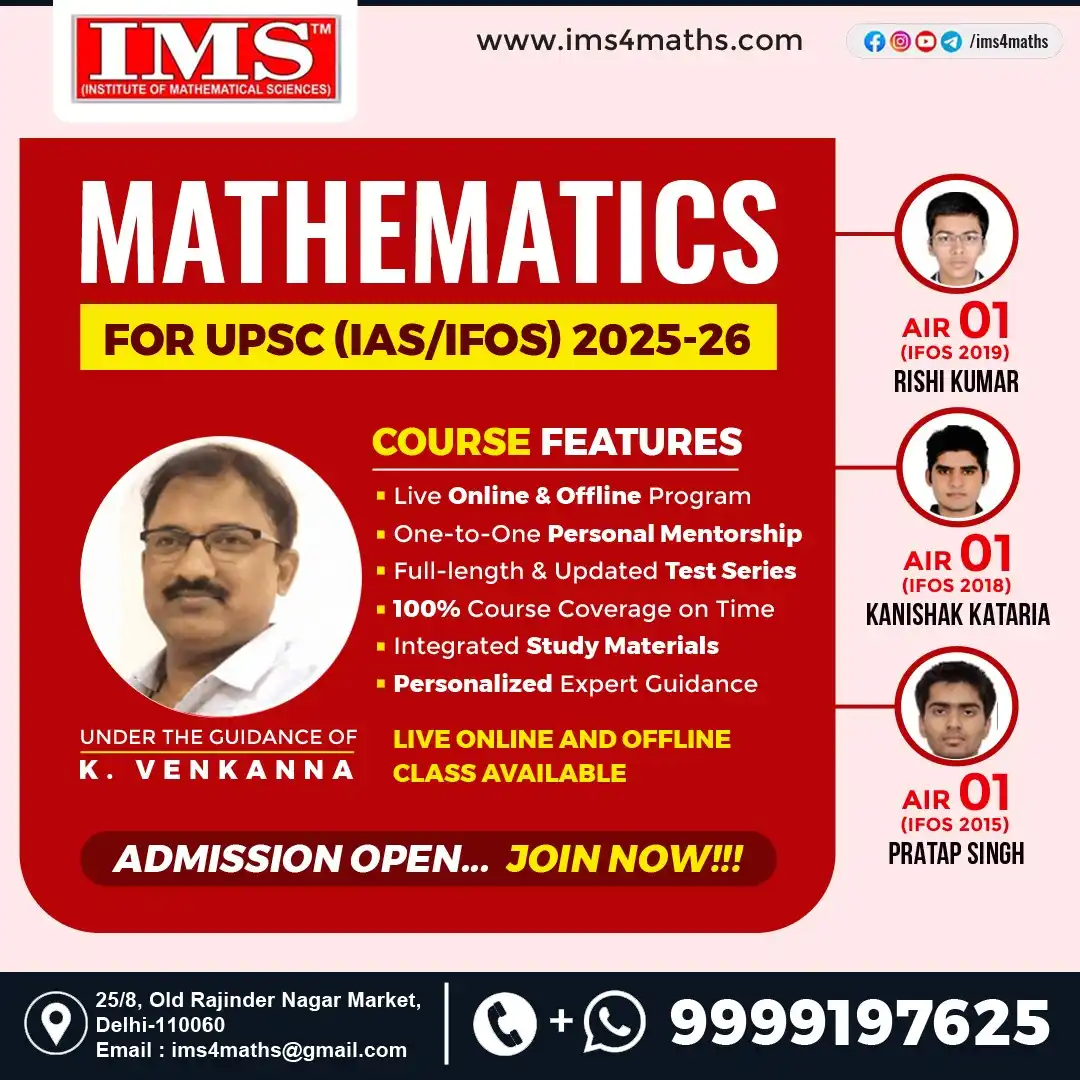
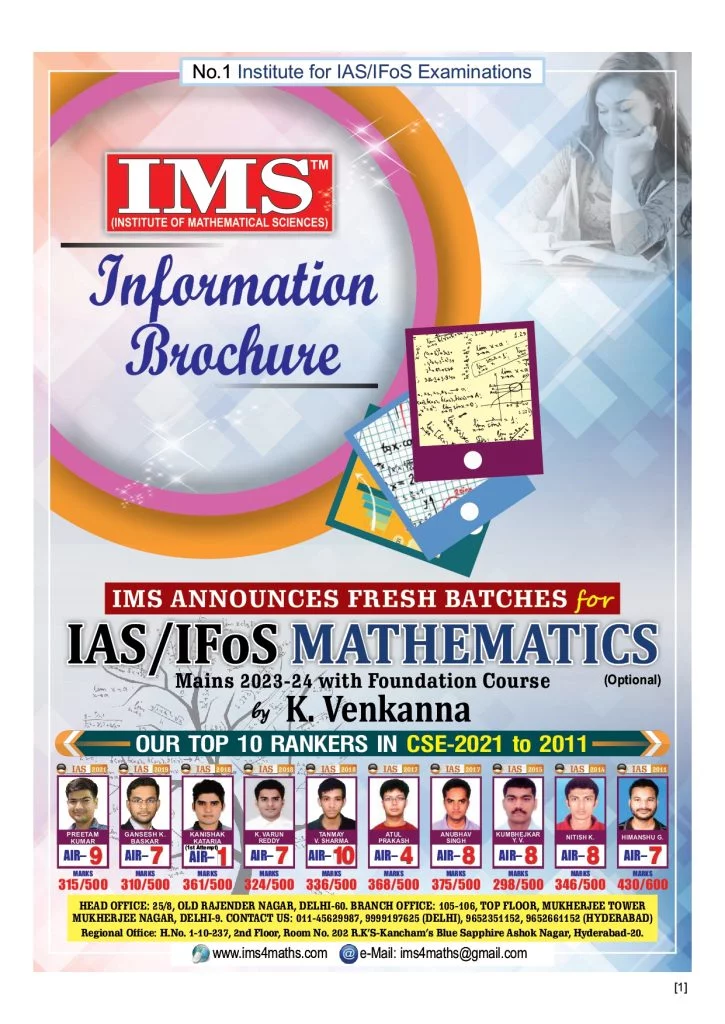
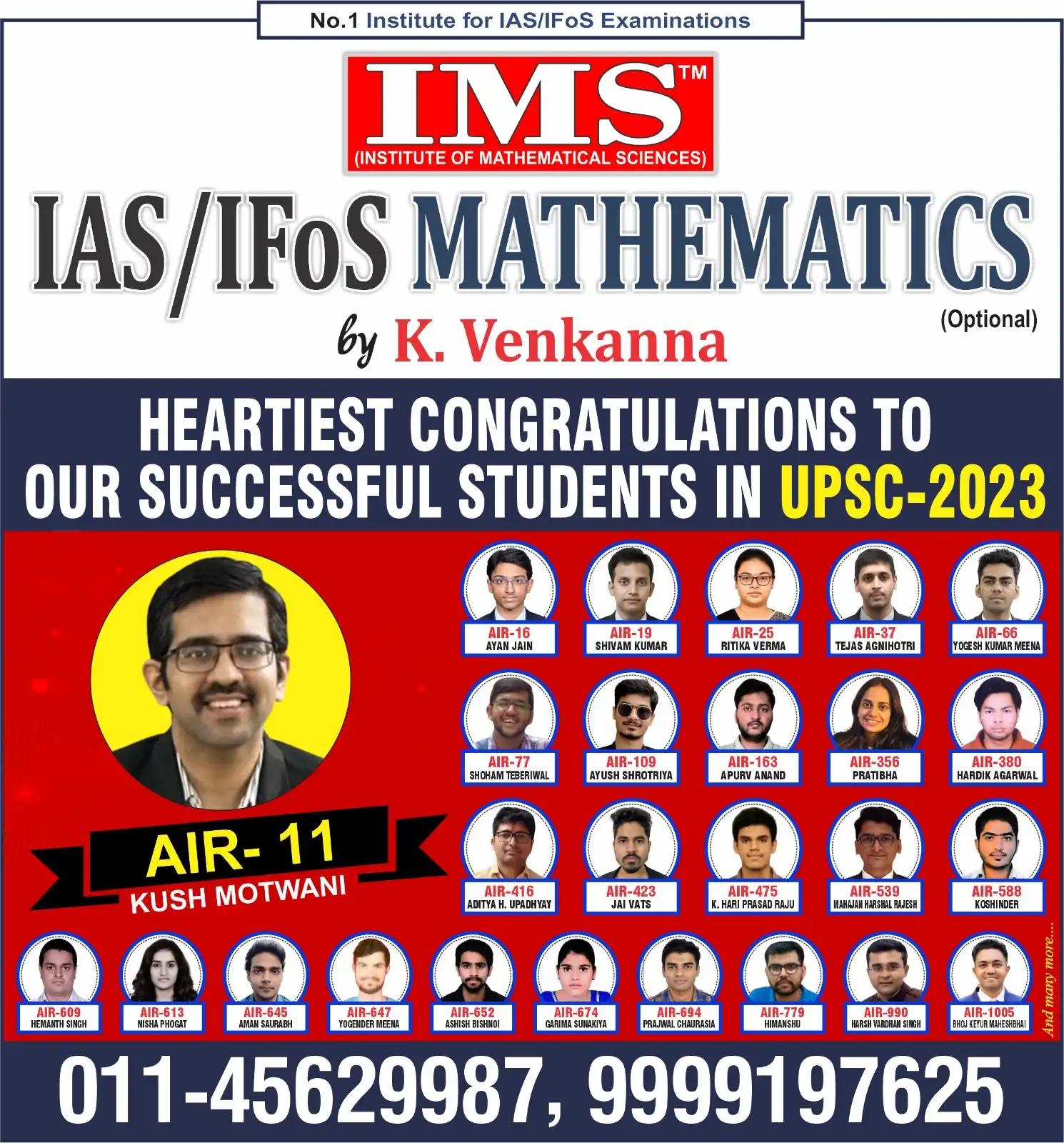
IMS4Maths, guided by K. Venkanna Sir, has long been regarded as a benchmark institute for UPSC Mathematics Optional preparation. Its offline reputation and academic depth were strong, but the digital presence did not reflect this excellence.
As UPSC aspirants increasingly relied on Google search, AI-style answers, and question-based discovery, IMS4Maths was not appearing consistently for important Maths Optional queries. The website structure was outdated, the content lacked clarity, and authority signals were weaker than competing institutes.
MgiWebzone was brought in to rebuild the digital foundation from the ground up. The focus was on aligning the institute’s online presence with modern search behaviour, strengthening authority, and creating a stable enquiry flow so serious aspirants across India could easily find and trust IMS4Maths.
Results That Transformed Their Online Presence
Digital Presence Transformed — More Visibility, More Calls, More Batches Filled
Major Digital Challenges Limiting Admissions Growth
Strong Academic Legacy, Weak Digital Foundation
IMS4Maths, led by the renowned K. Venkanna Sir, has long been a respected name in UPSC Mathematics Optional coaching. However, this strong offline reputation was not being reflected online. As aspirants increasingly relied on Google search, AI-generated summaries, and question-based discovery to shortlist institutes, IMS4Maths struggled to appear at the right decision moments.
The website was slow, outdated, and not fully mobile-friendly. Key Maths Optional programmes, test series, and previous year solution pages were either missing or poorly structured. Content lacked depth and did not clearly answer aspirants’ real doubts. Technical gaps further prevented search engines from properly crawling, indexing, and ranking important pages. As a result, serious aspirants often discovered competitors first, leading to irregular enquiries and unpredictable admissions despite high intent demand.
Key Issues Blocking Digital Growth
- Website not mobile optimised
- Slow page loading speed
- Outdated page layouts
- Thin course descriptions
- Missing Maths Optional pages
- Weak keyword mapping
- Crawl and indexing issues
- No clear conversion paths
- Limited authority backlinks
- Poor internal linking structure
Services We Provided
How We Executed the Transformation
Our Proven Playbook That Delivered Nationwide Visibility and Consistent Maths Optional Enquiries
-
Fresh Content Optimization Plan
We updated the thin content and added structured information on subjects and classes. This helped parents understand offerings easily and improved search relevance.
-
UX-Led Header and Footer Redesign
Navigation was simplified with clear links to class pages, subjects, and contact options. This helped users find information without confusion.
-
Created Subject and Course Pages
Dedicated pages for classes 7–12 and all key subjects helped the institute appear for high-intent searches like “Class 10 Maths tuition Dwarka”.
-
Image Compression and Alt Tags
Large images were compressed and labelled correctly. This improved loading speed and strengthened image-related SEO signals.
-
Dedicated Course Landing Pages
We created focused landing pages to convert tuition-related search traffic into direct calls and enquiries from parents.
-
Fixed Crawl and Indexing Issues
We corrected indexing gaps, improved sitemap structure, and ensured Google could easily discover and rank all important pages.
-
Regular Promotional Blog Posting
We published useful blogs answering common parent and student questions. This increased organic traffic and built topical authority.
-
Strong Internal and External Linking
Internal links improved page navigation, while quality backlinks boosted domain authority and ranking strength.
-
Technical SEO and Schema Setup
We added schema, fixed redirects, improved metadata, and optimised Core Web Vitals — building a strong technical foundation for long-term SEO growth.
Measurable Outcomes Delivered
Our Proven Playbook That Delivered Nationwide Visibility and Consistent Maths Optional Enquiries
Organic Impressions
Strong nationwide visibility across UPSC Maths Optional searches.
Organic Clicks
High-intent discovery from serious Maths Optional aspirants.
Growth in Top-10 Keywords
Top-10 rankings expanded from 156 to 770 keywords.
Keywords Ranked
Wide coverage across coaching, test series, and resource searches.
Trust Flow Growth
Improved authority and credibility for competitive Maths Optional terms.
Average CTR
Healthy engagement across high-intent Maths Optional queries.
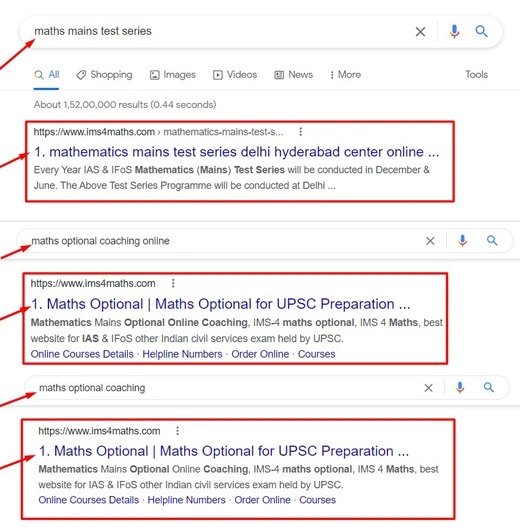
Strong Keyword Ranking Growth Nationwide
| Keywords | Ranks |
|---|---|
| maths optional coaching | 1st Page |
| maths optional coaching in delhi | 1st Page |
| maths optional coaching online | 1st Page |
| maths optional upsc coaching | 1st Page |
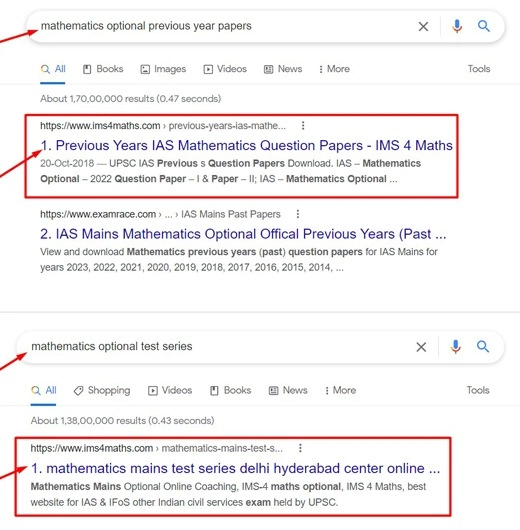
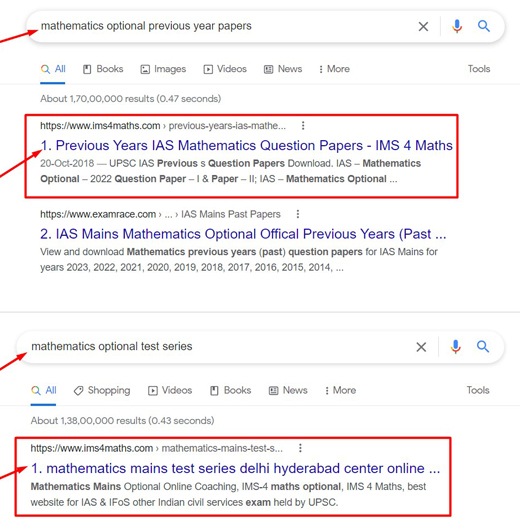
| mathematics optional previous year papers | 1st Page |
| upsc maths optional coaching | 1st Page |
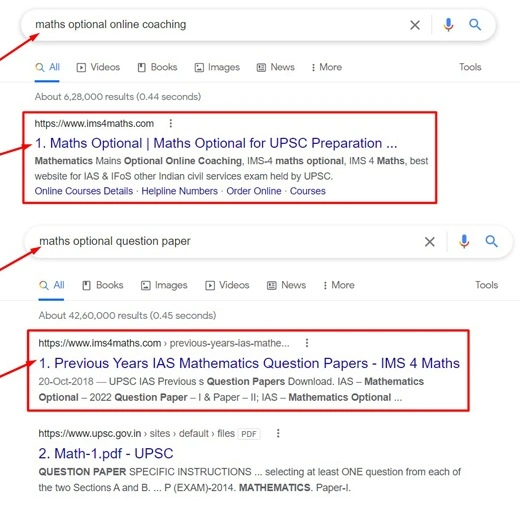
| maths optional question paper | 1st Page |
| maths optional online coaching | 1st Page |
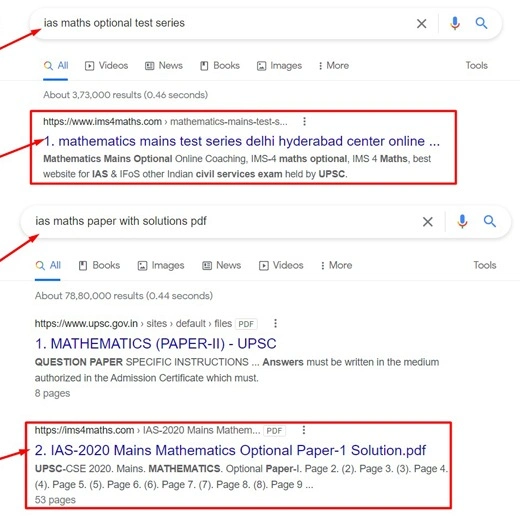
| ias maths paper with solutions pdf | 1st Page |
| maths optional paper upsc | 1st Page |
| mathematics optional coaching | 1st Page |
| mathematics optional coaching online | 1st Page |
| maths optional test series | 1st Page |
| ias maths optional test series | 1st Page |
| maths optional test series upsc | 1st Page |
| maths optional test series 2022 | 1st Page |
| maths mains test series | 1st Page |
| mathematics mains test series | 1st Page |
| upsc maths optional test series online | 1st Page |
| mathematics optional test series in delhi | 1st Page |
| test series for maths optional | 1st Page |
| online maths optional test series | 1st Page |

Ahrefs Metrics
Ahrefs Data Showed Stronger Backlinks, Higher Authority & Wider Keyword Reach
As backlinks and referring domains grew steadily, IMS4Maths gained stronger authority across UPSC Maths Optional searches. This improvement helped secure stable Top-10 rankings, wider keyword coverage, and consistent organic visibility among serious UPSC aspirants nationwide.
| Ahrefs Metrics | Before SEO | After SEO | Improvements in % |
|---|---|---|---|
| Backlinks | 11,179 | 37,500 | 235.67% |
| Referring Domains | 122 | 660 | 440.98% |
| Traffic | 28,500 | 39,566 | 38.93% |
| Keywords in Top 10 | 156 | 770 | 394.87% |
| Keywords in Top 50 | 308 | 1,700 | 451.95% |
| Keywords in Top 100 | 570 | 3,956 | 595.61% |

Moz Metrics Reflected Higher Authority and a Cleaner Trust Profile
Domain authority improved, spam score reduced, and the quality of backlinks increased. These improvements helped IMS4Maths build stronger trust with search engines and serious UPSC aspirants.
| Moz Metrics | Before Our Work | After Our Work | Improvements in % |
|---|---|---|---|
| Domain Authority | 23 | 47 | 104.35% Growth |
| Page Authority | 28 | 52 | 85.71% Growth |
| Spam Score | 10 | 1 | 90% Reduction |
| Off-Page SEO Score | 28% | 78% | 178.57% Growth |
| % of Quality Backlinks | 36% | 87% | 141.67% Growth |

Semrush Metrics
SEMrush Metrics – Wider Keyword Coverage & Organic Visibility
SEMrush showed strong growth across authority score, keyword coverage, organic traffic, and backlink expansion — signs of long-term ranking stability.
| SEMrush Metrics | Before Our Work | After Our Work | Improvements in % |
|---|---|---|---|
| Authority Score | 34 | 77 | 126.47% |
| Organic Search Traffic | 28,870 | 40,877 | 41.61% |
| Keywords | 500 | 7,900 | 1480% |
| Backlinks | 12,388 | 38,699 | 212.69% |
| Referring Domains | 155 | 709 | 357.42% |
Majestic Metrics
Majestic Metrics – Strong Trust Flow & Deep Link Strength
Majestic demonstrated major improvement in IMS4Maths’ link ecosystem. Higher Trust Flow, Citation Flow, and diverse referring IPs show a stable domain with strong authority signals preferred by search engines.
| Majestic SEO Metrics | Before Work | After Work | Improvements in % |
|---|---|---|---|
| Trust Flow | 27 | 47 | 74.07% |
| Citation Flow | 41 | 60 | 46.34% |
| Referring IPs (Historic) | 155 | 977 | 530.97% |
| Referring IPs (Fresh) | 105 | 549 | 422.86% |
| Referring Subnets (Historic) | 178 | 835 | 368.54% |
| Referring Subnets (Fresh) | 146 | 660 | 352.05% |
Using Social Visibility to Support Enquiry and Admissions Growth
Building Trust and Daily Visibility Among Maths Optional Aspirants

K.Venkanna
Frequently Asked Questions
IMS4Maths grew nationwide visibility by fixing the website foundation, improving content around real aspirant questions, and building stronger trust signals—so Google started showing them more often during the “decision stage” searches.
Before working with MgiWebzone, IMS4Maths was already well-known offline because of K. Venkanna Sir’s teaching. But online visibility was not stable. Students from different states were searching on Google for Maths Optional help, test series, and preparation strategy—yet IMS4Maths was not appearing consistently for those high-intent searches.
1) We fixed the website basics first
The site structure and technical issues were cleaned up so Google could properly read, index, and rank the most important pages. Mobile experience was also improved because most aspirants search on phones.
2) We aligned pages with real UPSC search behaviour
Instead of random marketing, we mapped the site around how aspirants search today—topic-based, question-based, and test-series-focused searches. This helped IMS4Maths show up again and again for Maths Optional queries.
3) We improved content depth and clarity
We strengthened key course and resource pages so they answered real student doubts clearly (like syllabus coverage, test series structure, and who the course is suitable for). This improved trust and reduced confusion.
4) We built stronger authority signals
By improving trust signals and link quality, IMS4Maths started holding stable positions instead of fluctuating—so visibility stayed consistent, not temporary.
The measurable result in 12 months
- 1.45 million impressions (IMS4Maths was seen widely in searches)
- 131,000 organic clicks (real visits without paying for each click)
- Top 10 keywords: 156 → 770 (394.87% growth)
- Top 50 keywords: 308 → 1,700 (451.95% growth)
- Top 100 keywords: 570 → 3,956 (595.61% growth)
- And overall, IMS4Maths reached a broader footprint of 7,900+ keywords, which shows strong nationwide discovery across many Maths Optional search variations.
Many institutes have strong teaching, but online they don’t show up at the right time. MgiWebzone helps by building a complete discovery system—so your expertise becomes visible on Google and converts into steady enquiries, not random traffic.
The main issue was never teaching quality. IMS4Maths has always been known for strong Maths Optional results under K. Venkanna Sir. The real problem was that their existing online marketing was not working in the right direction.
IMS4Maths already had a website and some digital activity, but it was not aligned with how UPSC aspirants actually search and decide today. Because of this, many serious students were searching online but still finding competitors first.
Key digital issues that were holding IMS4Maths back
1) Online presence existed, but without clear direction
There was online marketing happening, but it was scattered. Pages were not clearly mapped to student search intent, so visibility was inconsistent and unpredictable.
2) Slow and outdated mobile experience
The website was slow on mobile and cluttered in structure. Since most UPSC aspirants search on their phones, many students left before understanding the courses properly.
3) Important Maths Optional pages lacked clarity
Course pages, test series details, and preparation-related content did not clearly answer common student questions like:
- Who is this course for?
- How is the test series structured?
- What makes IMS4Maths different?
This reduced both rankings and student trust.
4) Weak keyword and content alignment
The content was not fully aligned with the exact search terms aspirants use, such as Maths Optional test series, preparation strategy, or online coaching queries. As a result, even high-intent searches were missed.
5) Technical SEO gaps
There were crawl and indexing issues, which means Google could not properly read and prioritise important pages. This silently limited rankings, even when the content quality was good.
6) No clear enquiry journey
Students who were interested did not always see a clear next step. Enquiry paths like landing pages, WhatsApp flow, or clear call actions were not optimised, so some potential leads were lost.
7) Digital trust signals were weak
Although classroom credibility was very strong, online authority signals (structure, content depth, consistency) were not enough to reflect that strength to search engines and new students.
How MgiWebzone helped solve this
MgiWebzone did not replace existing efforts blindly. Instead, we fixed what was already there but not working properly. The focus was on clarity, structure, student intent, and trust—so IMS4Maths could appear at the right time, for the right searches.
This is a common situation for many coaching institutes. Teaching is excellent, some online marketing is already running, but without the right system, results stay unstable. That is where MgiWebzone helps—by turning scattered digital activity into clear visibility, steady discovery, and consistent enquiries.
AI-ready and question-based content played a very important role in helping IMS4Maths grow its search visibility across India. This type of content matched how UPSC aspirants actually search today—through full questions, voice search, and AI-based answers, not just short keywords.
Earlier, IMS4Maths already had online marketing and content in place, but it was not structured around real student doubts. Most pages talked about courses in a general way, while students were searching questions like:
- “How to prepare for UPSC Maths Optional?”
- “Which Maths Optional test series is best?”
- “Is Maths Optional suitable for working professionals?”
Because these questions were not clearly answered on the website, Google and AI-style search results were not regularly showing IMS4Maths during the decision stage.
What changed with AI-ready, question-based content
1) IMS4Maths started appearing for direct answer searches
Content was rewritten in a clear question–answer format. This helped Google and AI systems easily pick IMS4Maths pages for answer boxes and AI overview-type results when students searched specific doubts.
2) Content matched how students actually think and decide
Instead of thin descriptions, IMS4Maths pages started explaining syllabus coverage, test series structure, difficulty level, and who the course is meant for. This built clarity and trust before a student even contacted the institute.
3) Better visibility in voice and mobile searches
Many aspirants search using voice on their phones. When content sounds natural and conversational, search engines understand it better. This helped IMS4Maths appear for voice-based and long queries.
4) Stronger authority and trust signals
When an institute consistently answers real doubts in depth, search engines start treating it as a subject expert. This helped IMS4Maths build stronger authority and more stable rankings over time.
Results supported by this content approach
This strategy played a key role in IMS4Maths achieving:
- 1.45 million search impressions
- 131K organic clicks
- 770 keywords in Google’s Top 10
- 7,900+ total keywords ranked
At MgiWebzone, the focus is not on writing content for search engines alone, but on answering real student questions in a simple, honest way. For IMS4Maths, this approach helped turn subject expertise into search visibility, trust, and steady enquiries.
If a coaching institute already teaches well but is not growing online, the problem is often not marketing spend—it’s content that doesn’t answer student doubts. That is exactly the gap MgiWebzone helps fill.
Authority-building and backlink quality played a big role in improving IMS4Maths’ rankings and online trust. IMS4Maths already had a strong offline name, but their earlier online marketing and backlinks were not structured properly. Because of this, Google was not fully confident about the site, so rankings were not as strong or as stable as they should have been.
Why authority and backlinks matter
Think of a backlink like a recommendation.
- If 2–3 random people recommend a shop, it helps a little.
- But if trusted people in the same market recommend that shop, everyone trusts it quickly.
Same way, when relevant and trusted education/UPSC websites link to IMS4Maths, Google starts seeing the brand as a real expert, not just another coaching website.
What was holding IMS4Maths back earlier
Even though IMS4Maths had backlinks, the problem was:
- Many links were random or low-value
- Important Maths Optional pages were not getting strong support
- Google could not clearly see the site as a top Maths Optional authority
- Rankings were up and down, and competitors were taking the top spots
What changed after authority-building was done properly
When authority-building was planned the right way, the impact became very clear:
1) Strong trust signals improved
- Trust Flow grew by 74%
This is a clear sign that the backlink profile became more trusted.
2) Rankings grew and became stable
- Top 10 keywords grew from 156 to 770 (394.87% growth)
This kind of growth usually happens only when Google starts trusting the site more consistently.
3) Wider visibility across search
- IMS4Maths reached 1.45 million impressions
Meaning, Google started showing the brand again and again to serious aspirants.
4) Better trust for students as well
Students don’t check backlinks directly, but they feel trust when:
- the institute appears repeatedly on Google
- pages rank steadily instead of disappearing
- the brand looks established, not “temporary”
That trust improves enquiry quality and helps admissions become more consistent.
At MgiWebzone, authority-building is not about “buying links” or doing random off-page work. It is about building clean, relevant, topic-based trust—so Google understands that your institute is genuinely strong in its niche. For IMS4Maths, the focus was simple:
- remove weak signals
- build quality backlinks in the right places
- strengthen trust so rankings become stable
If your institute is good but Google doesn’t trust your website enough, students won’t find you at the right time. Build authority the right way, and rankings plus enquiries start improving together.
Modern search behaviour is changing Optional subject coaching a lot, because students are no longer searching like “Maths Optional Delhi” only. Now they search like real conversations, and many times they don’t even click websites before deciding.
Here’s what’s happening and why it matters for your institute.
1) Students search with full questions, not short keywords
Earlier, a student typed: “UPSC Maths Optional coaching.” Now the same student asks:
- “Is Maths Optional good for beginners?”
- “Which test series is best for Maths Optional?”
- “Who is the best teacher for Maths Optional?”
Impact: If your website has only course names and basic pages, you won’t show up often. Google and AI tools prefer pages that answer doubts clearly, not pages that just “describe a course”.
2) AI Overviews show answers before websites
Google now shows an AI summary at the top for many queries. Students read that and then decide whether to click or not.
Impact: If your institute is not part of that “direct answer”, you lose visibility even if your rankings are decent.
That’s why AEO (Answer Engine Optimisation) matters—your content must be written in a way that search systems can easily pick and show.
3) Voice search is growing fast
Many aspirants search on phone like they speak:
“Best optional for UPSC?”
“Maths Optional coaching near me”
“IMS4Maths test series details”
Impact: Voice searches use simple, natural language. If your content is too formal, too short, or too unclear, you get skipped.
4) Optional subject decisions are trust-based
Optional coaching is not an impulse decision. Students:
- compare 2–4 institutes
- check faculty credibility
- read test series details
- look for proof, PYQ strategy, and structure
Impact: If your site doesn’t build trust through clear explanations, FAQs, results, and strong pages, students move to a competitor who “looks more reliable” online.
What coaching institutes should do now
To stay ahead in 2026-style search, Optional coaching sites need:
- content that answers real student questions (not generic paragraphs)
- clear headings and short summaries (easy for AI to pick)
- pages for test series, PYQs, syllabus coverage, and guidance
- strong local presence (Google profile, map signals, reviews)
- a smooth enquiry path (WhatsApp/call/form)
This is exactly where many good institutes get stuck: teaching is strong, but online discovery is weak.
MgiWebzone helps coaching institutes build a complete “search-to-enquiry” system—so your institute can appear in Google results, AI Overviews, and question-based searches, and then convert that visibility into real enquiries.
If your website doesn’t answer student questions clearly, modern search systems won’t push you. If your content and structure match how students search today, Optional subject coaching growth becomes more steady and less dependent on ads.
By 2026, Google will work more like an Answer Engine, not just a list of links. So UPSC/IAS coaching admissions will depend less on “who has a website” and more on who gets picked inside Google’s AI answers.
Here’s the impact in a clear way:
1) “Zero-click” will become normal
Many students will get the key answer on Google itself (AI Overview / summary) and may not click 5–6 websites like before.
What this means for admissions:
If Google’s AI mentions your institute in that summary, you get trust and leads faster. If you’re not mentioned, you can become invisible even if your teaching is strong.
Example searches students ask now:
- “Which is the best coaching for Maths Optional?”
- “Is Maths Optional good for working professionals?”
2) Trust will matter more than just keywords (E-E-A-T)
Google’s AI will prefer institutes it can trust. Not because you wrote “best coaching” 20 times, but because the internet shows you as real and reliable.
Google looks for signals like:
- clear faculty identity and experience (real profiles, not generic text)
- strong student reviews and reputation
- helpful content that answers doubts properly
- consistent mentions and links from relevant sites
This is why institutes like IMS benefited once their online trust signals became stronger.
3) Students are searching in full questions + voice
Instead of typing short words, students now ask full doubts, and many do it through voice search on mobile.
- “How to start Maths Optional from zero?”
- “Which test series matches UPSC pattern?”
Impact: If your site is written in a natural Q&A style and explains things simply, it has a better chance to show up in:
- AI answers
- featured snippets
- voice-based results
4) Local + national discovery will mix together
AI search will combine:
- location (near me / city)
- subject need (Optional / GS / test series)
- intent (research vs ready-to-enrol)
So, a smaller institute can get nationwide discovery if it explains well and looks trustworthy. At the same time, a well-known offline institute can lose admissions if its online presence looks weak or confusing.
5) What coaching owners should do now
To protect admissions in 2026, coaching websites should:
- answer student doubts clearly (not only course selling lines)
- structure pages properly (course, test series, syllabus, FAQs, results)
- build real authority signals (quality mentions + links, clean profile)
- keep enquiry path simple (WhatsApp, call, short form)
- make the website fast and mobile-first
This is not “extra work” now. It’s basic survival for future search.
Most coaching institutes don’t lose admissions because teaching is weak. They lose because Google’s AI doesn’t understand their value or doesn’t trust their online signals.
MgiWebzone helps by building a complete system:
- content that AI can pick as answers
- trust signals that support rankings
- clean website structure + easy enquiry path
So, when students ask questions, your institute becomes the option they keep seeing and trusting.
In 2026, Google’s AI will decide who gets seen first. Coaching brands that build clarity + trust will get steady enquiries. Those who ignore AI-driven search will slowly lose admissions—even with good classroom results.
A full-funnel digital growth system is more effective than doing SEO alone because admissions don’t happen just by ranking on Google. Coaching institutes don’t need only traffic — they need the right students, strong trust, and a simple enquiry path.
SEO mainly helps you get found.
A full-funnel system helps students find you → trust you → contact you → take admission.
Why SEO alone often fails for admissions
SEO usually focuses on:
- keyword rankings
- impressions and clicks
- basic on-page changes
That’s useful, but many coaching owners still face this: “Traffic is coming, but enquiries are very few.”
This happens when:
- the site doesn’t answer real student doubts
- course pages feel unclear or generic
- enquiry buttons are hidden or forms are long
- there is no proper landing page for key courses/test series
- there is no tracking, so you don’t know what converts
So students visit… compare… and leave.
What a full-funnel system does (the complete journey)
1) Reach students even before they search
Not every student is searching daily on Google. Many are:
- watching YouTube
- scrolling Instagram/Telegram
- asking doubts in groups
A full-funnel system builds visibility across channels so students recognise your name before they even type a search.
2) Get discovered at the decision stage
SEO still matters, but it must match today’s search style:
- question-based searches
- AI Overviews / direct answers
- voice-style queries
That’s why a full-funnel system includes AI-ready content + strong page structure, not only “keyword stuffing”.
3) Build trust quickly
Optional subject coaching is a high-trust decision. Students and parents check:
- faculty credibility
- course clarity
- results and reviews
- proof that you are stable and genuine
A full-funnel system builds trust using:
- clear content (not just marketing lines)
- strong testimonials and proof
- a clean, professional website experience
4) Convert visits into enquiries (the most missed part)
Even interested students won’t enquire if the website journey is confusing. A full-funnel system fixes conversion by:
- dedicated landing pages (course/test series)
- simple WhatsApp/call buttons
- short forms and clear next steps
- fast mobile speed (most students search on phone)
5) Track what is bringing admissions
SEO reports alone often show rankings, but not admissions. A full-funnel system tracks:
- Which pages bring enquiries
- Which keywords lead to calls/WhatsApp
- Where students drop off
- Which channel is giving better leads
This is how you improve month by month, instead of guessing.
Simple example
SEO alone is like putting a big hoarding on a highway. People may see it, but may not stop.
A full-funnel system is like:
- your hoarding + your shop signage + helpful staff + easy billing
So the person not only comes, but also buys.
A real example: IMS
In the IMS project, growth didn’t come from “SEO alone”. The real improvement came when the whole journey was fixed — visibility, trust, and enquiry flow working together. That’s how IMS reached 1.45 million impressions and 131,000 clicks in 12 months, and the visibility started supporting more consistent enquiries.
At MgiWebzone, the focus is not “doing tasks like SEO only”. We build a complete growth system so your teaching quality becomes visible online and converts into admissions.
Many coaching owners tell us, “We don’t want only traffic. We want stable admissions.” That is exactly what a full-funnel digital growth system is designed for.
SEO helps students find you.
A full-funnel system helps students choose you.
UPSC coaching institutes can get high-quality student leads without expensive ads by building a strong organic system that helps serious aspirants find you, trust you, and contact you easily. Ads can bring leads fast, but organic growth brings steady enquiries without burning money every month.
Here’s a simple, practical plan you can follow.
1) Get found for “high-intent” searches (not random traffic)
Serious UPSC aspirants don’t search only “UPSC coaching”. They search like this:
- “Best test series for UPSC Maths Optional”
- “How to prepare for UPSC Optional while working”
- “Which faculty is good for answer writing?”
If your website answers these kinds of queries clearly, you attract students who are already close to decision. Those leads are naturally better than broad ad leads.
2) Use Local SEO + Google Maps (biggest low-cost lead source)
Most institutes ignore Google Maps, but it brings very strong enquiries. Do these basics properly:
- Keep phone, address, timings, course details updated
- Add good photos, classroom images, results posters
- Collect real reviews from students (with simple wording)
When someone searches “UPSC coaching near me” or “UPSC optional coaching in Delhi”, a strong Google profile gives you leads without paying per click.
3) Write content that clears doubts, not just “we are best”
High-quality leads come when a student feels: “This institute understands my problem.”
So your content should:
- explain course structure in simple language
- cover syllabus, test series pattern, who it’s for
- answer common doubts honestly
- guide what to do next (call/WhatsApp/form)
IMS is a good example. They already had online marketing, but once their content started answering real Optional doubts properly, search visibility and serious enquiries became more consistent.
4) Make your website fast + mobile-friendly (or leads leak out)
Even if you rank, you lose leads if:
- The site loads slowly on mobile
- Pages are confusing
- The enquiry button is hard to find
A good website should feel like a clean admission desk:
- fast opening
- clear course pages
- simple enquiry form
- WhatsApp + call buttons visible
5) Use YouTube/Reels to build trust (organic lead machine)
Students trust faces more than posters. Low-cost content ideas:
- short concept videos
- “how to approach Optional” guidance
- topper/student stories
- class clips (even 30–60 seconds)
This builds familiarity. Later, when the same student searches on Google, they contact you faster.
6) Match the new 2026 search style (AI answers + voice search)
Now, many students search as they speak:
- “Which optional is best for UPSC?”
- “Is Maths Optional scoring?”
If your website has clear Q&A style content, it becomes easier for Google’s AI summaries and voice results to pick your name. That means more discovery without ads.
Many coaching owners don’t need “more ads”. They need a steady lead engine.
MgiWebzone helps institutes build that system by improving:
- discovery (Google + Maps + question searches)
- trust (faculty + proof + helpful content)
- conversion (landing pages, WhatsApp/call flow)
- consistency (so enquiries don’t depend only on paid campaigns)
If you want better leads without expensive ads:
Be easy to find, easy to trust, and easy to contact. That’s what brings serious UPSC enquiries again and again.
SEO is usually better than Google Ads for long-term admission growth for UPSC coaching institutes — but only when SEO is done properly (content + trust + conversions), not just “keyword work”.
At the same time, Google Ads are not “bad”. Ads are great for quick admissions when you have a new batch, limited seats, or an urgent target. The real win is knowing what to use for what purpose.
Direct answer
- Google Ads = fast results, but they stop the day you stop paying.
- SEO = slow start, but it keeps giving admissions for months and years.
So for long-term growth, SEO is the stronger option.
Why Google Ads feel powerful (but don’t build a base)
Google Ads work like a switch:
- Turn ON budget → you get visibility and clicks
- Turn OFF budget → your visibility disappears
This becomes costly in UPSC coaching because:
- Education keywords are expensive
- Many leads are “just enquiring”, not ready to join
- Parents and serious aspirants trust organic results more than “Sponsored”
Ads can fill seats, but ads don’t build your long-term brand on search.
Why SEO becomes your long-term admission engine
SEO is like building your own asset. When your pages start ranking:
- You get steady enquiries without paying per click
- You show up during research + comparison + decision stage
- You build trust because students see you as a “real option”, not just an ad
And in 2026 search, SEO is not only “Google links”. Good SEO also means:
- question-based content (AEO style)
- clear course pages
- trust signals (faculty, results, reviews)
- fast mobile experience
- strong authority through quality mentions/links
Simple example
- Ads = renting a shop on a busy road
- SEO = owning the shop
Rent helps you start today. Owning helps you grow for years.
A real case reference: IMS4Maths
IMS4Maths is a good example of this balance. They can use ads for quick pushes when needed, but their stable growth came when the focus moved to:
- strong SEO foundation
- question-based content students actually search
- trust and authority building
- clear enquiry paths (call/WhatsApp/form)
That’s when enquiries became more consistent, instead of depending only on paid campaigns.
Best approach for most UPSC coaching owners
If you want a practical plan:
Phase 1 (Start + Stabilise)
- Run limited ads for urgent seats
- Fix website speed and pages
- Start SEO + AEO content
Phase 2 (Reduce ad dependency)
- Grow rankings for decision-stage questions
- Build authority and trust signals
- Make SEO the main lead source
This way, you don’t get stuck in “monthly ad spend stress”.
At MgiWebzone, we don’t force a “SEO vs Ads” fight. We help coaching institutes build a system where:
- Ads support launches (when needed)
- SEO builds long-term admissions
- your growth doesn’t stop if ad budget pauses
So the goal stays simple: stable enquiries + stable admissions.
If you want quick leads, Google Ads helps. If you want long-term admission growth, SEO is better. And the smartest institutes use both, but with SEO as the base.
Finding the right digital marketing partner for a UPSC coaching institute is not like hiring an agency for a café, gym, or local shop. The UPSC market is trust-heavy, highly competitive, and aspirants are very smart. They compare institutes, read reviews, check faculty, and take time before paying fees. So your partner must understand how UPSC students think and search, not just how to “run SEO” or “run ads”.
Here’s a simple way to choose the right partner:
1) Check if they truly understand the UPSC ecosystem
A good partner should be comfortable with coaching terms and student behaviour like:
- Optional subjects, Prelims vs Mains, test series, answer writing
- The fact that students ask deep questions before deciding
- The reality that trust and clarity matter more than “flashy posters”
Example: For IMS, it was important that the partner understood how to present K. Venkanna Sir’s teaching strength online in a credible way, because in Optional coaching, authority matters a lot.
2) Ask for education-specific proof, not generic promises
Don’t get impressed by “we will rank you on Google” lines. Instead, ask:
- What was the problem in that institute’s digital setup?
- What exactly did you fix?
- What measurable growth came after that?
Real proof looks like clear numbers and outcomes.
For example, in the IMS journey, growth like 1.45M impressions and 131K clicks shows strong visibility — but the more important part is whether that visibility was built to support steady enquiries and admissions, not random traffic.
3) See if they are ready for 2026 search behaviour
In 2026, students don’t just type short keywords. They ask full questions and rely on AI-style summaries. So your partner must understand:
- Question-based searches (student doubts)
- AI-ready content approach (so your institute can appear in answer-style results)
- Clear page structure, strong trust signals, and content that can be “picked” as an answer
If an agency is still only talking about “keyword stuffing” or basic ranking reports, they are behind.
4) Make sure they think beyond SEO packages
UPSC admissions don’t happen only because of rankings. A good partner should talk about the full student journey:
- Being found (search + question-based discovery)
- Building trust (faculty, results, clarity, reviews)
- Converting interest into enquiry (WhatsApp, call, forms, landing pages)
- Tracking what’s working (so you improve month by month)
If they only sell “SEO package” without discussing enquiries and admissions, you’ll likely face the common issue: traffic comes, but conversions don’t.
5) Judge them by communication and transparency
A good digital partner:
- explains in simple language
- shares clear action plans
- doesn’t confuse you with heavy technical words
- tells you what will happen in 30/60/90 days realistically
Avoid agencies that over-promise or hide behind reports.
MgiWebzone works more like a growth partner for coaching institutes, not a “task vendor”. The focus is on building a full system that matches how UPSC aspirants search, compare, and decide — and then turning that visibility into stable enquiries.
If you’re a coaching owner who wants steady admissions, not just rankings and reports, that’s exactly the kind of support MgiWebzone is built for.
Quick checklist before finalising any agency
- Do they have real coaching/education case studies?
- Do they talk about admissions and enquiry quality (not only traffic)?
- Do they understand UPSC students and optional-subject trust?
- Do they have an AI-ready and question-based content plan for 2026?
- Do they explain things clearly and honestly?
If most answers are “yes”, you have found a partner who actually understands the Indian UPSC coaching market.
Yes, MgiWebzone is a reliable digital marketing partner for UPSC and Optional subject coaching institutes, especially for institutes that want steady admissions—not just random traffic or short-term ad spikes.
Here’s the real reason in simple words: UPSC students don’t enrol in one day. They research, compare, read doubts, check faculty credibility, and only then contact an institute. MgiWebzone plans marketing exactly around this student behaviour.
Why coaching institutes trust MgiWebzone
1) They understand the UPSC market properly
UPSC marketing is not like restaurant or local shop marketing. Aspirants:
- compare 2–4 institutes before paying
- search in full questions (not just keywords)
- trust faculty proof, results, and clarity
MgiWebzone focuses on being visible during the research + decision stage, not only “running ads”.
2) Strong Optional subject experience
Optional coaching is a “trust game”. Students want:
- clear course structure
- real guidance approach
- proof that the faculty is strong
- answers to doubts like test series format, syllabus coverage, who it suits, etc.
This is why institutes like IMS (strong in classroom already) needed support in digital clarity + discovery, so students across India could find them easily online.
3) They work for admissions, not just rankings
Many agencies only show:
- keyword reports
- impressions
- ranking screenshots
MgiWebzone focuses more on:
- enquiry quality
- trust building
- better conversion paths (WhatsApp, call, enquiry forms)
- stable admission flow
Because traffic without enquiries is useless for a coaching owner.
4) Proof-based results (not only promises)
MgiWebzone shares measurable outcomes and case study performance. For example, IMS achieved:
- 1.45M impressions
- 131K clicks
- strong keyword growth across Top 10 / Top 50 / Top 100
- improved authority signals (like Trust Flow uplift)
This shows execution, not just talk.
5) Ready for 2026 search behaviour (AI + question searches)
In 2026, students will:
- read Google AI summaries
- search in question style
- use voice search
- trust “answer-style” pages more than marketing posters
MgiWebzone works on AI-ready content structure + AEO-style answers + clean authority signals, so institutes don’t go invisible as search changes.
6) Simple communication and a clear process
A reliable partner is not the one who uses heavy marketing words. A reliable partner is the one who:
- explains work in simple language
- gives a proper plan
- shows what is working and what is not
- improves month by month, not just one-time work
That’s one strong reason coaching owners stay with MgiWebzone.
If your institute has strong teaching, but:
- students are not finding you online,
- enquiries are up and down,
- ads feel expensive and unstable,
Then MgiWebzone is a reliable option because they work like a digital growth partner—building visibility + trust + enquiry flow, not only “SEO tasks”.