

The Complete UPSC Coaching Market Guide for Institute Owners
- Real Market Numbers Most Owners Miss
- 6 Student Segments and Their Course
- Why the Market Compounds Every Year
- Why AI Search Visibility Now Matters
- From Local Coaching to Pan-India Reach
- 26 Optional Subjects — 26 Sub-Markets
- How to Fill Batches With Digital Systems
Request a Quote
How Big is the UPSC Coaching Market in India: Official Data, Student Segments, Revenue Estimates, and Growth Trends (2026)

Most coaching institute owners think their market is roughly 6 lakh students — the number who appeared in UPSC Prelims this year. That number is real. It is also the wrong number to build a business around.
The actual addressable market — when you factor in repeat aspirants across multiple attempt cycles, students who start preparing two to four years before their first attempt, and the fact that one aspirant buys from multiple coaching providers — is estimated at 15 to 25 lakh active students at any given time.
The gap between 6 lakh and 25 lakh is not a rounding error. It is where most coaching institutes are leaving enrolments on the table.
This article documents the full picture: official UPSC exam statistics from 2007 to 2025, six student segments, the aspirant life cycle, seven product categories, and revenue estimates across every segment. All data is sourced and labelled so you can use it with confidence.
Table of Contents
How Big is the UPSC Coaching Market in India?
Officially, around 5.5 to 6 lakh candidates have appeared in UPSC Prelims annually in recent years. That is the surface number. The real coaching market is considerably larger — because most aspirants attempt the exam multiple times, many begin buying coaching products two to four years before they sit their first exam, and a single aspirant commonly buys from several different providers across their preparation journey.
The market spans seven distinct course categories: GS Foundation coaching, optional subject coaching, Prelims test series, GS Mains test series, optional subject test series, Mains answer writing courses, and module wise courses.
Estimated total active aspirant pool: 15 to 25 lakh students across all preparation stages. (Derived estimate — not an official UPSC figure).
Estimated total UPSC coaching market value: ₹3,500 crore to ₹22,000 crore annually. (Derived estimate based on participation data, fee ranges, and coaching participation rates — not audited or officially published).
MgiWebzone works exclusively with UPSC coaching institutes across these segments — which is why this data set exists in this form.
Data-driven Digital Marketing Results for UPSC/IAS Coaching Institutes
The Official UPSC Exam Funnel (2007–2025): What the Confirmed Numbers Show
The exam funnel is the data foundation. Before any market estimate, this is what the official records confirm.
UPSC Exam Funnel: Selected Years 2007–2025
CSE Year | Applied (Prelims) | Appeared (Prelims) | Appearance Rate | Qualified for Mains | Finally Selected |
2007 | 3,33,680 | 1,61,469 | 48.4% | 9,158 | 734 |
2012 | 5,50,080 | 2,71,442 | 49.3% | 12,795 | 998 |
2014 | 9,47,428 | 4,46,623 | 47.1% | 16,706 | 1,236 |
2018 | 10,65,552 | 5,00,484 | 47.0% | 10,419 | 759 |
2019 | 11,35,697 | 5,68,282 | 50.0% | 11,845 | 829 |
2021 | 11,12,318 | 5,08,619 | 45.7% | 9,214 | 748 |
2022 | 11,35,697 | 5,73,735 | 50.5% | 13,090 | 933 |
2023 | ~13,35,697 | ~6,00,000 | ~44.9% | 14,624 | 1,016 |
2024 | 9,92,599 | 5,83,213 | 58.8% | 14,627 | 1,009 |
2025 | 9,37,876 | 5,76,793 | 61.5% | 14,161 | 1,087 |
Source: UPSC Annual Reports (58th through 73rd Annual Reports, covering exam years up to CSE 2021); UPSC and PIB press releases for CSE 2022–2025. CSE 2023 applied and appeared figures are estimates from multiple consistent secondary sources — not officially confirmed in a standalone press release.
Why “Applied” is a Misleading Business Metric — and “Appeared” is the Right Demand Signal
In CSE 2016, nearly 60% of all applicants did not sit the exam on the day. The application count includes a large share of aspirants who registered but never prepared seriously. It overstates the committed market.
The appeared figure is the real demand signal. It represents students who committed enough to show up on exam day — the ones who are enrolled in coaching, buying test series, and making active preparation decisions.
The appearance rate hit 61.5% in CSE 2025 — the highest in the entire data set going back to 2007. CSE 2024’s 58.8% was the previous high. Two consecutive years at the top of the chart. In our reading of this pattern, the rising appearance rate is one of the clearest signals that the UPSC coaching market is becoming more serious, not more diluted. And that is structurally good news for every coaching institute.
The 1-in-530 Success Rate — Why It Creates a Permanent Coaching Market
In CSE 2025, 5,76,793 students appeared in Prelims. 1,087 were finally selected. That is a success rate of 0.19%.
UPSC Success Rate (2018–2025)
CSE Year | Appeared (Prelims) | Finally Selected | Success Rate | 1-in-X Ratio |
2018 | 5,00,484 | 759 | 0.15% | 1 in 659 |
2019 | 5,68,282 | 829 | 0.15% | 1 in 686 |
2021 | 5,08,619 | 748 | 0.15% | 1 in 680 |
2022 | 5,73,735 | 933 | 0.16% | 1 in 615 |
2024 | 5,83,213 | 1,009 | 0.17% | 1 in 578 |
2025 | 5,76,793 | 1,087 | 0.19% | 1 in 530 |
Source: UPSC Annual Reports and PIB press releases.
At 1 in 530, structured preparation is not optional for most aspirants — it is the rational response to what the exam demands. This is the commercial case for coaching. Not a marketing claim. Arithmetic.
A coaching institute that makes this point clearly in its content is speaking to the real fear every aspirant carries. Reaching these committed aspirants through digital marketing begins with understanding why they are searching in the first place.
Find Out How Many Students Are Already Searching for Your Coaching Institute
Get a free visibility check. No commitment. Just clarity.
Why the Official Funnel Still Understates the Real Coaching Market
The funnel table above shows one year of one cohort moving through one exam cycle. The coaching market does not work this way.
UPSC Annual Reports track exam-stage movement — not coaching-stage demand. A student who begins preparing in Class 12 and appears in CSE 2028 is in the coaching market from 2024 onwards. The funnel will show them in 2028. The coaching market already counted them four years earlier.
A student who fails CSE 2024 Prelims and returns for CSE 2025 disappears from the 2024 funnel count. But they never left the coaching market. They are joining a new test series. They may be switching optional coaching. They are actively making preparation decisions.
And one aspirant preparing over three to four years may buy several course or classes from different coachings — none of which appears as a single transaction in the exam data.
The UPSC exam funnel measures exam competition. It does not fully measure coaching demand.
Your Coaching Niche Has a Market. Let's Make Sure Students Can Find You.
MgiWebzone builds AI-ready SEO strategies specifically for UPSC coaching institutes.
Why the Real UPSC Coaching Market Compounds Every Year
The exam funnel shows one cohort in one year. The coaching market runs across multiple cohorts simultaneously. Three structural reasons explain why the real market is several times larger than the yearly appeared figure.
Layer 1 — The Market Compounds Because Candidates Attempt Multiple Times
The average successful UPSC candidate clears in their third or fourth attempt. That means students who appeared in CSE 2022, 2023, and 2024 are still in the preparation system in 2026 — still enrolled in coaching programmes, still buying test series, still making course decisions.
The coaching market from any single exam year does not disappear after results. It persists. And it adds to itself.
Estimated total active aspirant pool at any given time: 15 to 25 lakh students across all preparation stages. (This is a derived estimate based on multi-attempt cycle analysis — not an official UPSC figure).
Layer 2 — Students Start Joining Coaching 2–4 Years Before They Appear
India produces approximately 1.5 crore Class 12 passouts every year. Even 0.3% with serious UPSC aspiration represents around 45,000 new early-stage students entering the coaching pipeline annually — before they have appeared in a single Prelims exam.
These students are already joining foundation courses, optional subject orientation material, and early preparation resources. They do not appear in the UPSC funnel data. But they are very much in the coaching market.
Layer 3 — One Aspirant Buys From Multiple Institute Over Multiple Years
A single aspirant preparing over three to four years may join GS Foundation coaching from one institute, optional subject coaching from a second, a Prelims test series from a third, a Mains answer writing course from a fourth, and current affairs coaching from a fifth.
The coaching market is not 6 lakh students. It is 6 lakh students each making several distinct joining decisions, from different coaching classes, across different preparation stages.
Think about it this way — even capturing one joining moment from each aspirant in a 5-lakh Prelims cohort is still a five-lakh-student market. Capture two moments and your effective market doubles.
Knowing how to attract the right students at each stage of the UPSC preparation journey is the starting point for any coaching institute that wants to grow beyond its existing student base.
Discover How Our Expert Solutions Can Elevate Your Online Presence
- Boost Online Visibility Fast
- Get More Quality Leads
- Rank Higher on Google
The Coaching Market vs Selected Ratio: 504 Students for Every Seat
There is one number that puts everything above into a business perspective.
Estimated Coaching Market vs Finally Selected (2019–2025)
CSE Year | Est. Active Coaching Market (Prelims × 95%) | Finally Selected | Coaching Market : Selected Ratio |
2019 | ~5,39,868 | 829 | ~651:1 |
2021 | ~4,83,188 | 748 | ~646:1 |
2022 | ~5,45,048 | 933 | ~584:1 |
2024 | ~5,54,052 | 1,009 | ~549:1 |
2025 | ~5,47,953 | 1,087 | ~504:1 |
Coaching market figure = Prelims appeared × 95% estimated coaching participation rate. This is a derived estimate. Selection figures from UPSC Annual Reports and PIB press releases.
In CSE 2025, approximately 504 students were enrolled in some form of coaching for every one candidate finally selected. That ratio has held between 504:1 and 651:1 across seven consecutive exam cycles.
This is structural demand. Not seasonal. Not dependent on this year’s results or notification calendar. It does not disappear after results day — it renews. Because most of those 504 students will try again.
Tired of paying for ad traffic that never enquires?
MgiWebzone builds UPSC-specific campaigns targeting aspirants by subject, city, and exam preparation stage.
Who Actually Join UPSC Coaching? The 6 Core Student Segments
UPSC coaching students are not one audience. They come from mainly six distinct life stages with different urgencies, different search behaviour, and different willingness to pay. An institute that understands this can market to the right person with the right message — rather than broadcasting to everyone and converting very few.
UPSC Coaching Joiner Segments at a Glance
Segment | Age | Main Course Need | Key Platform | Commercial Value |
Post-Class 12 Early Starters | 17–20 | Foundation courses | YouTube, Instagram | Highest lifetime value |
College-Stage Preparers | 19–24 | GS + optional + test series | YouTube, Google, Telegram | Largest segment |
Fresh Graduates (Full-Time) | 22–26 | Full coaching bundles | Google Search | High purchase intensity |
Working Professionals | 25–35 | Online/recorded courses | Google, LinkedIn | Fast-growing, high-spend |
Repeat Aspirants | 22–32 | Test series, answer writing, optional | Google, Telegram | Most profitable repeat |
Final-Stage Aspirants | 22–35 | Interview coaching | Google Search | Smallest volume, highest benifits |
Segment 1 — Post-Class 12 Early Starters (Age 17–20)
These students have the longest preparation timeline — three to five years before their first attempt. That makes them the highest lifetime-value student for any coaching institute that can reach them early.
They are heavily influenced by YouTube toppers and Instagram success stories. Tina Dabi (AIR 1, CSE 2015, at age 22, first attempt) and similar young rankers are the aspiration anchors for this group. The decision to enrol often involves parents — which means effective marketing here needs to reach two audiences simultaneously: the student and the family.
Approximately 45,000 new early-stage students enter the coaching pipeline every year. Primary platforms: YouTube, Instagram Reels.
Segment 2 — College-Stage Preparers (Age 19–24)
This is the largest single segment and the primary revenue driver for most coaching institutes. India has approximately 4 crore enrolled graduates. Even 2% actively preparing for UPSC represents 80 lakh potential students.
IIT and NIT final-year students are a significant sub-segment here. Aditya Srivastava (AIR 1, CSE 2023, IIT Kanpur, Electrical Engineering optional, scored 308/500) is the aspiration anchor for this group. His story — from AIR 236 in one year to AIR 1 the next, using his own engineering degree as his optional subject — is one of the most shared preparation stories in recent UPSC history.
This segment researches, compares, and often join coaching entirely online without visiting physically. Primary platforms: YouTube, Google Search, Instagram, and college Telegram groups.
Segment 3 — Fresh Graduates Preparing Full-Time (Age 22–26)
High-intent, research-heavy Google searchers. This segment reads review articles, compares faculty, checks fee structures, and reads testimonials before making a decision. They are the most likely to convert from a well-ranked blog or a targeted Google Ad.
The entire course joining journey for this segment happens online. SEO for UPSC coaching websites is directly relevant here — an institute that does not appear in their Google searches at the research stage will not be on their shortlist at the decision stage.
Segment 4 — Working Professionals (Age 25–35)
This segment barely existed at a commercial scale a decade ago. Today, it is one of the fastest-growing demand drivers in UPSC coaching.
IT professionals in Bengaluru and Hyderabad preparing alongside full-time jobs represent a commercially underserved group. They search late at night — often at 10pm or 11pm after work. They have income and are willing to pay for quality. But they cannot attend physical batches. They need online, recorded, and flexible formats.
The challenge is reaching them at the right moment, in the right format. Google Ads for UPSC coaching institutes — particularly time-targeted evening campaigns — is the most direct channel for this segment. Primary platforms: Google Search (late-night), YouTube, LinkedIn.
Segment 5 — Repeat Aspirants (2nd Attempt Onwards)
Approximately 5.3 to 5.7 lakh students fail Prelims every year. Many of them come back. And when they do, their behaviour is very different from a first-timer.
They are not looking for motivation. They already have that. They are looking for a better system than the one that did not work last year. They actively compare institutes and test series providers. Their previous experience makes them decisive, not hesitant. Primary platforms: Google Search, coaching Telegram groups.
Segment 6 — Final-Stage Aspirants (Mains and Interview Focus)
The smallest by volume — and, in practice, the segment where most coaching institutes no longer charge a fee at all.
Interview guidance has largely shifted to a free offering across the industry. The business logic is straightforward: if a student who attended your mock interview panel goes on to make the final selection list, their photograph and success story becomes marketing material worth far more than any fee you could have charged them. One AIR in the double digits, attributed publicly to your institute, fills batches in a way that no Google Ad can replicate.
There is another layer to this. Students preparing for the UPSC interview do not restrict themselves to one institute. Most attend three or four different mock interview sessions at different coaching centres — covering different panels, different questioning styles, different feedback perspectives. So the competition for their time and presence is real, even when there is no fee involved.
What this means commercially: interview guidance is a brand-building investment, not a revenue stream. The institutes that run high-quality interview panels — and then use the results strategically in their marketing — build credibility that compounds across every other product they offer. The student who got into the final list after your mock interview session is now your most powerful proof point for optional coaching, GS Foundation batches, and test series enrolments.
Primary platform: Google Search — time-critical, high-intent searches from Mains-qualified candidates immediately after results are declared.
The UPSC Student Life Cycle: What Students Enrol in at Each Stage
UPSC preparation is not a one-time decision. It is a staged journey of enrolments that can span four to six years. Each stage has its own courses, its own urgency, and its own marketing logic.
UPSC Student Life Cycle and Course Demand
Preparation Stage | Main Courses Join | Students Urgency |
Pre-attempt (Class 12 / early graduation) | GS Foundation, optional orientation courses | Low — planning stage |
Active Prelims preparation | GS coaching, optional coaching, Prelims test series | High |
Post-Prelims failure (repeat cycle) | New Prelims test series, optional revision coaching | Very high |
Mains preparation | Optional coaching, GS Mains test series, answer writing | Very high |
Post-Mains, pre-interview | Interview coaching | Extremely high — time-critical |
Post-Mains failure | Optional revision coaching, Mains test series | High — motivated to change |
Each row in this table is a separate marketing moment. And a separate revenue opportunity. An institute marketing only to students preparing for the Prelims is capturing one row out of six. The others are passing by.
And here is the real issue for most institutes — they are not even capturing the one row they are targeting, because they are not visible when those students search. See advertising ideas for each stage of the UPSC preparation cycle for practical approaches to reaching students at each of these moments.
MgiWebzone passes all five of these tests
- 12+ years
- 1,000+ education clients
- 98% client satisfaction
- 94% first-page rankings secured
Seven Revenue Streams: The UPSC Coaching Course Market and Its Estimated Value
The UPSC coaching business is not one course. It is seven distinct revenue streams, each with its own student volume, fee range, competitive landscape, and buying cycle. Understanding this map helps a coaching institute owner decide where to grow — and where to focus digital marketing effort.
UPSC Coaching Course Market Estimates (2026-27)
Course Segment | Est. Annual Students | Fee Range (Per Student) | Est. Annual Market Value |
GS Foundation (Prelims + Mains) | 1,00,000–2,00,000 | ₹25,000–₹80,000 | ₹2,500 Cr–₹16,000 Cr |
Optional Subject Coaching | 6,00,000–10,00,000 | ₹15,000–₹60,000 | ₹900 Cr–₹6,000 Cr |
Prelims Test Series | 4,00,000–5,00,000 | ₹4,000–₹15,000 | ₹160 Cr–₹750 Cr |
GS Mains Test Series | 12,000–15,000 | ₹10,000–₹20,000 | ₹12 Cr–₹30 Cr |
Optional Subject Test Series | 10,000–14,000 | ₹7,000–₹20,000 | ₹7 Cr–₹28 Cr |
Mains Answer Writing Courses | 8,000–12,000 | ₹8,000–₹20,000 | ₹6.4 Cr–₹24 Cr |
Interview Coaching | 1,000–2,500 | ₹15,000–₹50,000 | ₹1.5 Cr–₹12.5 Cr |
Total UPSC Coaching Market (India) | — | — | ₹3,500 Cr–₹22,000 Cr+ annually |
All figures in this table are estimates derived from UPSC Mains participation data, observed fee ranges, and coaching participation rates. They are not audited or officially published figures. The wide range reflects the economic difference between a small local institute and a large national coaching brand.
Three things stand out from this table.
Optional subject coaching — estimated at ₹900 crore to ₹6,000 crore — is the most fragmented segment in the entire market. No single brand dominates across all 26 optional subjects. That is exactly where a well-positioned niche institute has the most room to grow. The student who searches for the best Sociology optional coaching or the best Anthropology optional is not brand-loyal — they are actively choosing. An institute that appears first in that search wins the enquiry.
GS Foundation carries the highest absolute revenue but is also the most competitive. For most institutes without a national brand, optional coaching or test series offers a meaningfully better marketing return on the same spend.
The Prelims test series market — 4 to 5 lakh students annually at ₹4,000 to ₹15,000 per student — is the most self-renewing product in the ecosystem. It refills every exam cycle without fail.
SEO packages for UPSC coaching institutes are particularly effective for the optional subject and test series segments — where student search intent is specific, and the competition to rank is far lower than it is for generic GS coaching terms. For high-intent paid reach, Google Ads packages for UPSC coaching allow precise targeting by subject, location, and search intent.
Is your UPSC coaching institute visible on AI search, voice search, and social media?
MgiWebzone builds complete, 360° digital marketing strategies for education institutes — covering SEO, Ads, Social, Content, and AI visibility.
The Repeat Aspirant Economy: The Market That Renews Itself Every Year
Of all the structural features of the UPSC coaching market, this is the one most coaching institutes are not actively marketing to — despite the numbers being impossible to ignore.
Here is what the official data shows:
Approximately 5.3 to 5.7 lakh students fail Prelims every year. This figure is derived from the difference between Prelims appeared and Mains qualified, sourced from UPSC Annual Reports. Even if only 30% of them attempt again the following year, that is 1.6 to 1.7 lakh returning aspirants — actively looking for a new coaching option, a new test series, or a better preparation approach.
Approximately 13,000 students fail Mains each year, based on the Mains appeared figures from UPSC Annual Reports and PIB releases. If 70% of them join a new optional coaching programme or GS Mains test series, that is approximately 9,100 repeat enrolment per exam cycle.
The repeat aspirant test series market alone — just from students who failed in the previous cycle and returned — is estimated at ₹136 crore to ₹144 crore per year. (Repeat rate and rejoin rate are market-based estimates. Base Prelims and Mains figures are from official UPSC sources).
And this is where most test series providers completely miss the opportunity. Their most willing student is not the first-timer who is still figuring out whether to take the exam seriously. It is the student who has already invested a full year of preparation, did not clear, and is now actively searching for something better. There are an estimated 1.6 to 1.7 lakh of these students in the market every single year.
They are comparing. They are reading review articles at 11pm. They are asking in Telegram groups. The institute that appears when they search gets the enquiry. For practical approaches to reaching this segment specifically, see advertising strategies for reaching UPSC repeat aspirants.
The Optional Subject Market: 26 Sub-Markets, Each With Different Opportunity
The UPSC coaching market for optional subjects is not one market. It is 26 separate sub-markets — each with a different student volume, different trend direction, and different commercial opportunity for a coaching institute.
How Optional Coaching Markets Are Estimated — The Pipeline Formula
Official Mains participation data from UPSC Annual Reports shows how many students appeared in Mains with each optional subject. But coaching for optional subjects begins much earlier — at the Prelims preparation stage. Students choose and begin preparing for their optional long before they have cleared Prelims.
So, the real coaching market for any optional subject is far larger than its Mains count suggests.
The formula: Subject’s Mains candidates × Prelims-to-Mains ratio × coaching participation rate = estimated Prelims-stage coaching pipeline.
In CSE 2021, the Prelims-to-Mains ratio was 56.9 (5,08,619 appeared in Prelims; 8,930 appeared in Mains). Coaching participation rate among serious Prelims aspirants is estimated at 95%.
Worked example using PSIR: 1,571 (PSIR Mains candidates, CSE 2021) × 56.9 × 95% = approximately 84,900 students in the PSIR optional coaching pipeline at the Prelims stage. (Source: UPSC 73rd Annual Report for the Mains base figure. The pipeline figure is a derived estimate).
That is not 1,571 students. That is 84,900. The difference between those two numbers is the difference between an institute that targets only Mains-qualified students and one that markets to the full preparation pipeline.
How the Optional Landscape Reshuffled Between 2012 and 2021
Optional Subject Year-wise Rankings: Selected Years
Rank | 2012 | 2017 | 2021 | Post-2021 Trend |
#1 | Public Administration (7,077) | Geography (2,669) | PSIR (1,571) | Rising ↑ |
#2 | Geography (4,351) | Sociology (1,421) | Anthropology (1,159) | Rising ↑ |
#3 | Sociology (2,490) | PSIR (1,246) | Sociology (1,087) | Strongly rising ↑ |
#4 | History (2,090) | Public Administration (1,165) | Geography (1,079) | Declining ↓ |
#5 | Psychology (1,163) | History (1,074) | Mathematics (513) | Steady → |
Source: UPSC Annual Reports (official data 2012–2021). Post-2021 trend direction is based on topper performance data and estimated participation analysis — not official published figures.
Public Administration held 58% of all Mains optional candidates in 2012. By 2021, that share had collapsed entirely. PSIR, Anthropology, and Sociology now dominate the top three spots. An institute that understood this shift in 2017 and pivoted its optional coaching portfolio accordingly is in a completely different competitive position today than one that did not.
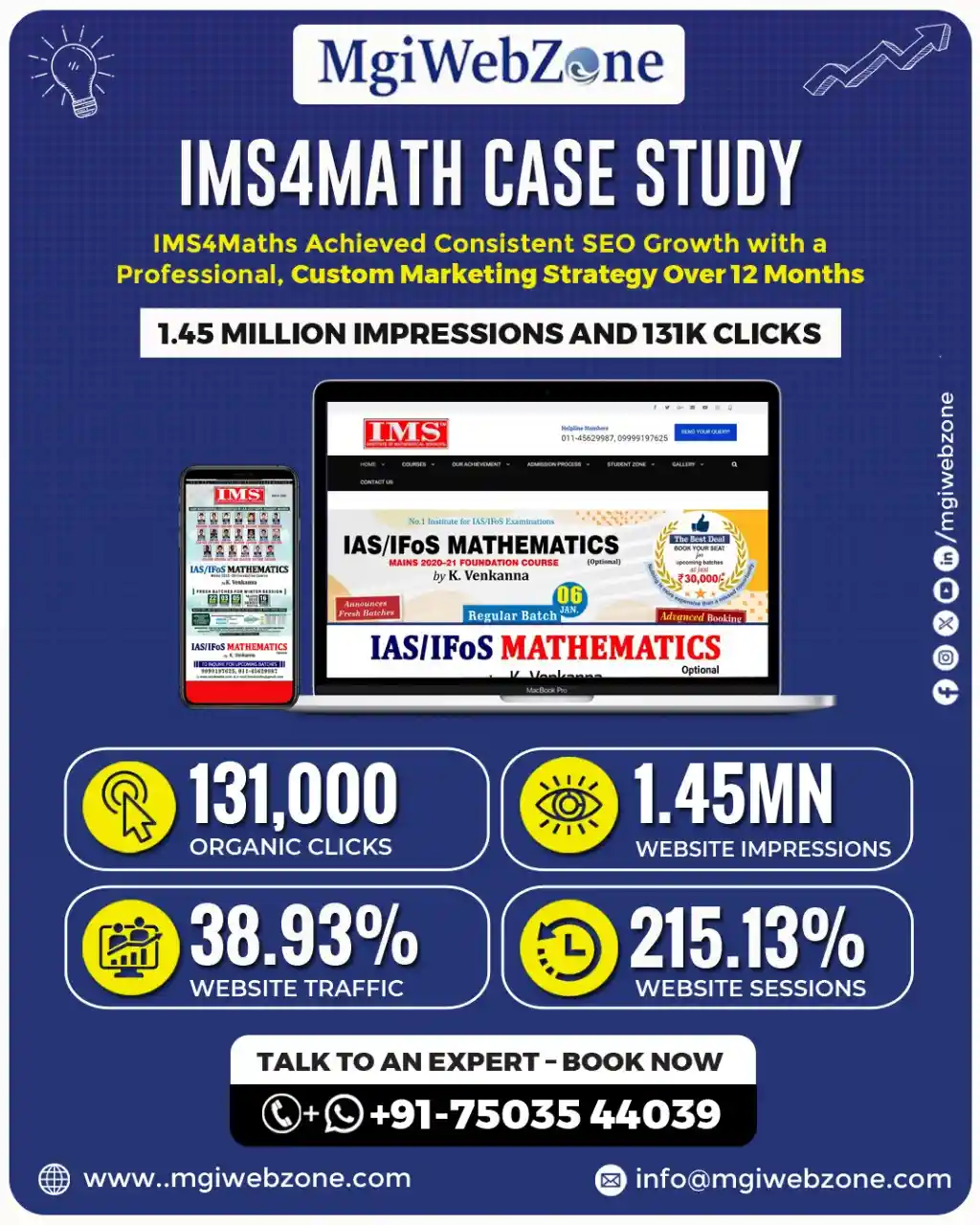
This is the kind of market intelligence that separates a confident growth decision from a guess. IMS4Maths reached 1.45 million impressions and 1,31,000 clicks with structured SEO — built entirely around the Mathematics optional segment — is a practical demonstration of what subject-specific digital positioning can deliver.
Topper Signals — What Recent Results Tell Coaching Institutes About Demand
Topper performance is not a vanity metric for coaching institutes. It is a leading demand indicator. When a subject produces an AIR 1 or top-3 result, aspirant interest in that optional rises sharply in the following preparation cycle. Coaching enquiries begin within weeks of results being announced.
Key recent signals — all verified from official UPSC merit lists:
1) PSIR: Both AIR 1 and AIR 2 in CSE 2024 chose PSIR. In CSE 2025, AIR 6 and AIR 9 chose PSIR. Estimated Mains participation has now crossed 2,000 candidates — up from 1,571 in CSE 2021. (Post-2021 figures are estimates based on topper data and trend analysis.)
2) Sociology: 4 of the top 10 in CSE 2024 chose Sociology. In CSE 2025, AIR 2 (Rajeshwari Suve M), AIR 5 (Ishan Bhatnagar), and AIR 10 (Ujjwal Priyank) chose Sociology. Estimated Mains participation: 1,200–1,700 and still rising.
3) Electrical Engineering: AIR 10 Rahul Srivastava in CSE 2022, followed by AIR 1 Aditya Srivastava in CSE 2023 (IIT Kanpur, scored 308 out of 500 in EE optional). Two consecutive top-10 results — the strongest two-year run for any engineering optional in the single-optional era.
4) Medical Science: AIR 1 Anuj Agnihotri in CSE 2025 — an MBBS graduate from AIIMS Jodhpur. This is the first Medical Science AIR 1 in recent UPSC history. Every MBBS student who saw this result in March 2026 heard the same message: your subject can take you to the top. Demand for Medical Science optional coaching is expected to surge sharply in the CSE 2026-27 preparation cycle.
5) Anthropology: AIR 3 Uma Harathi N (CSE 2022), AIR 3 Donuru Ananya Reddy (CSE 2023 — first attempt), AIR 7 in CSE 2025. Three top-10 results in three consecutive exam cycles. Consistently strong.
From Mukherjee Nagar to Pan-India: How UPSC Coaching Discovery Has Changed
For decades, Mukherjee Nagar and Old Rajinder Nagar in Delhi were the physical centres of Indian civil services preparation. Students relocated from Patna, Lucknow, Jaipur, and Hyderabad specifically to attend coaching in these hubs. Enrolling in a Delhi coaching institute was itself seen as a preparation signal.
That model has shifted. Not disappeared — shifted.
Online and recorded courses have created genuinely viable coaching options outside Delhi. Working professionals in Bengaluru, Hyderabad, Pune, and Chennai now complete full optional coaching programmes without relocating. Students in Guwahati, Indore, Bhopal, and Prayagraj are buying Prelims test series and GS courses entirely online.
The market is no longer bounded by geography. An optional subject coaching institute in Delhi can enrol a student from Vizag. A test series provider in Chennai can serve a student in Chandigarh. But only if they are visible when that student searches.
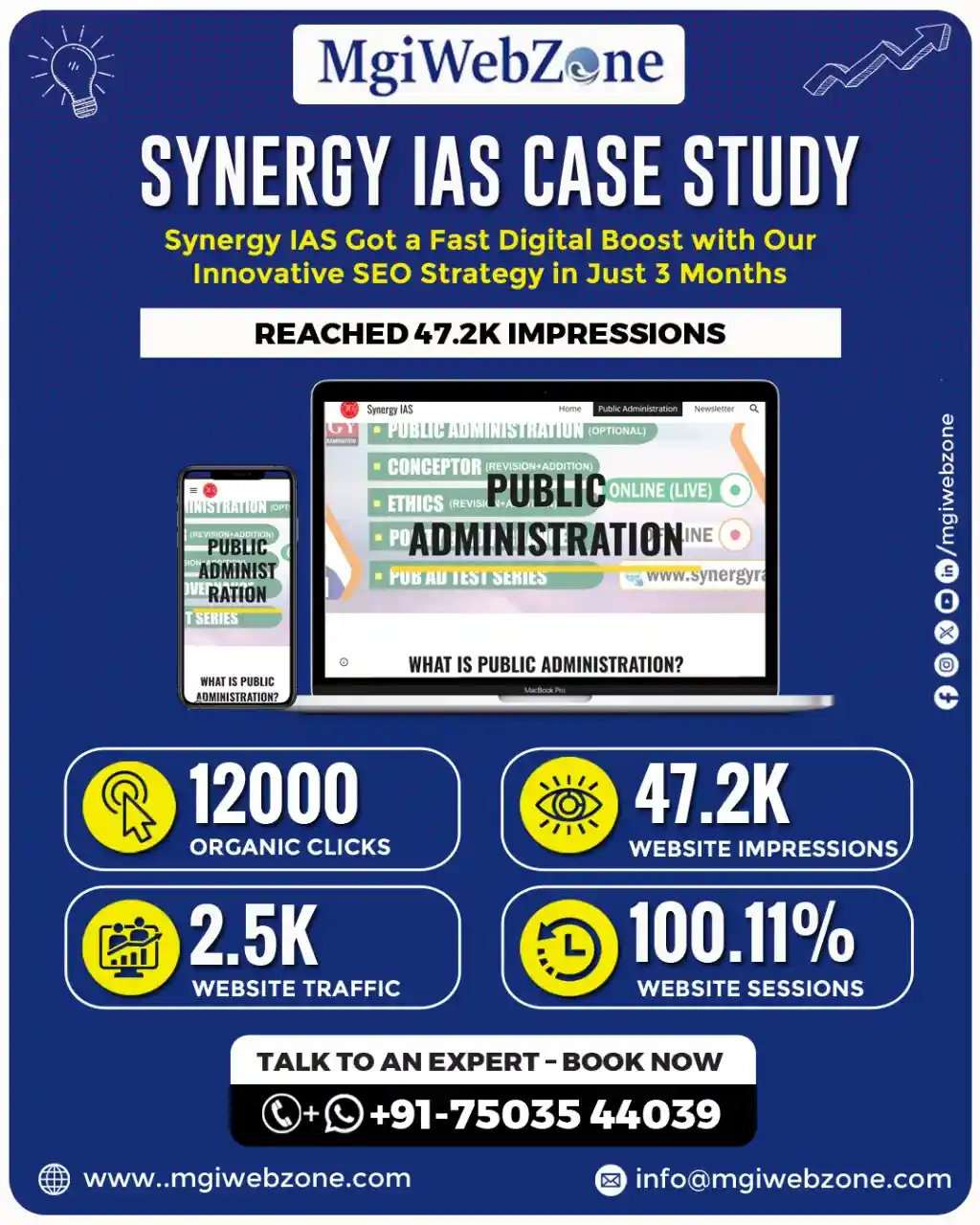
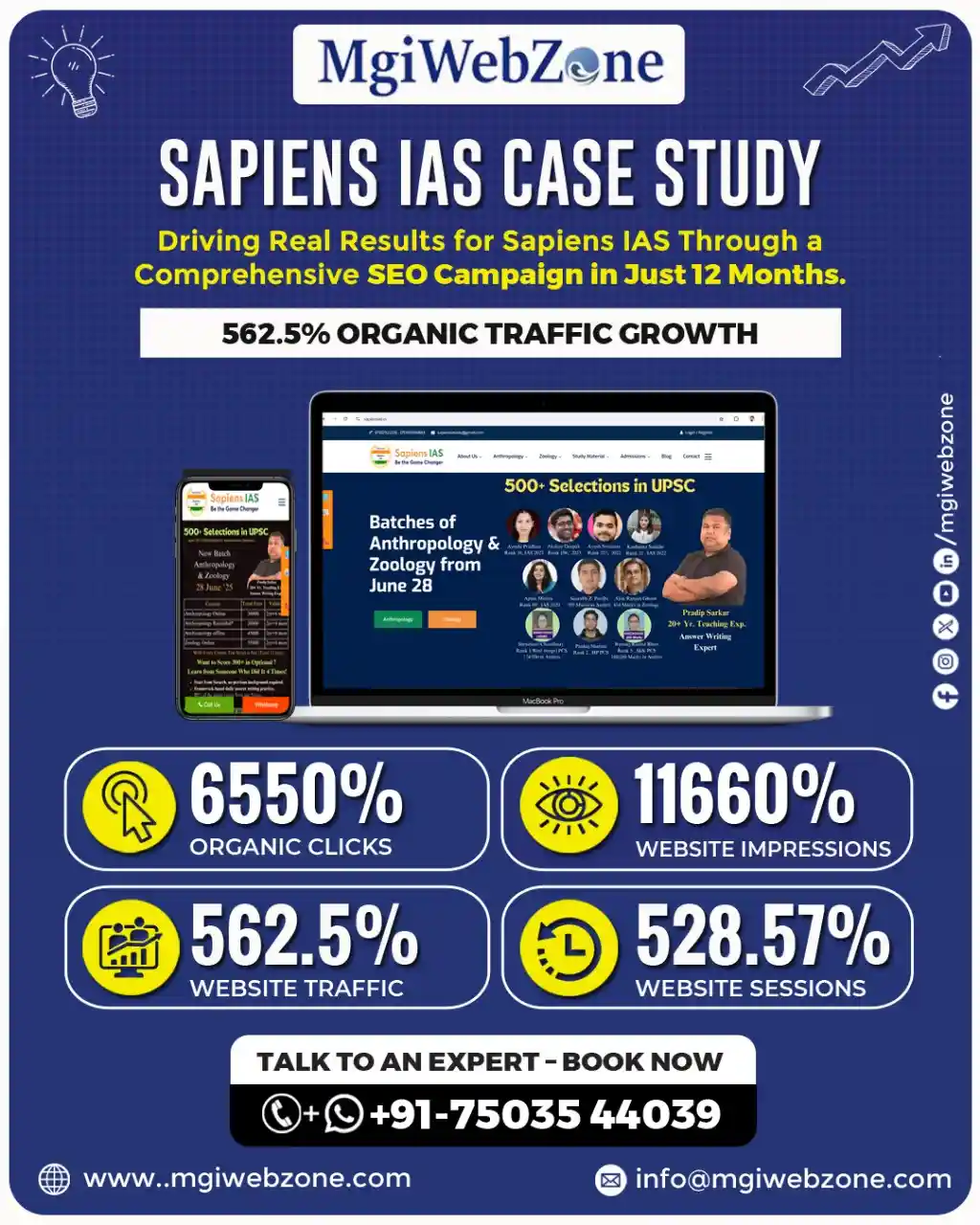
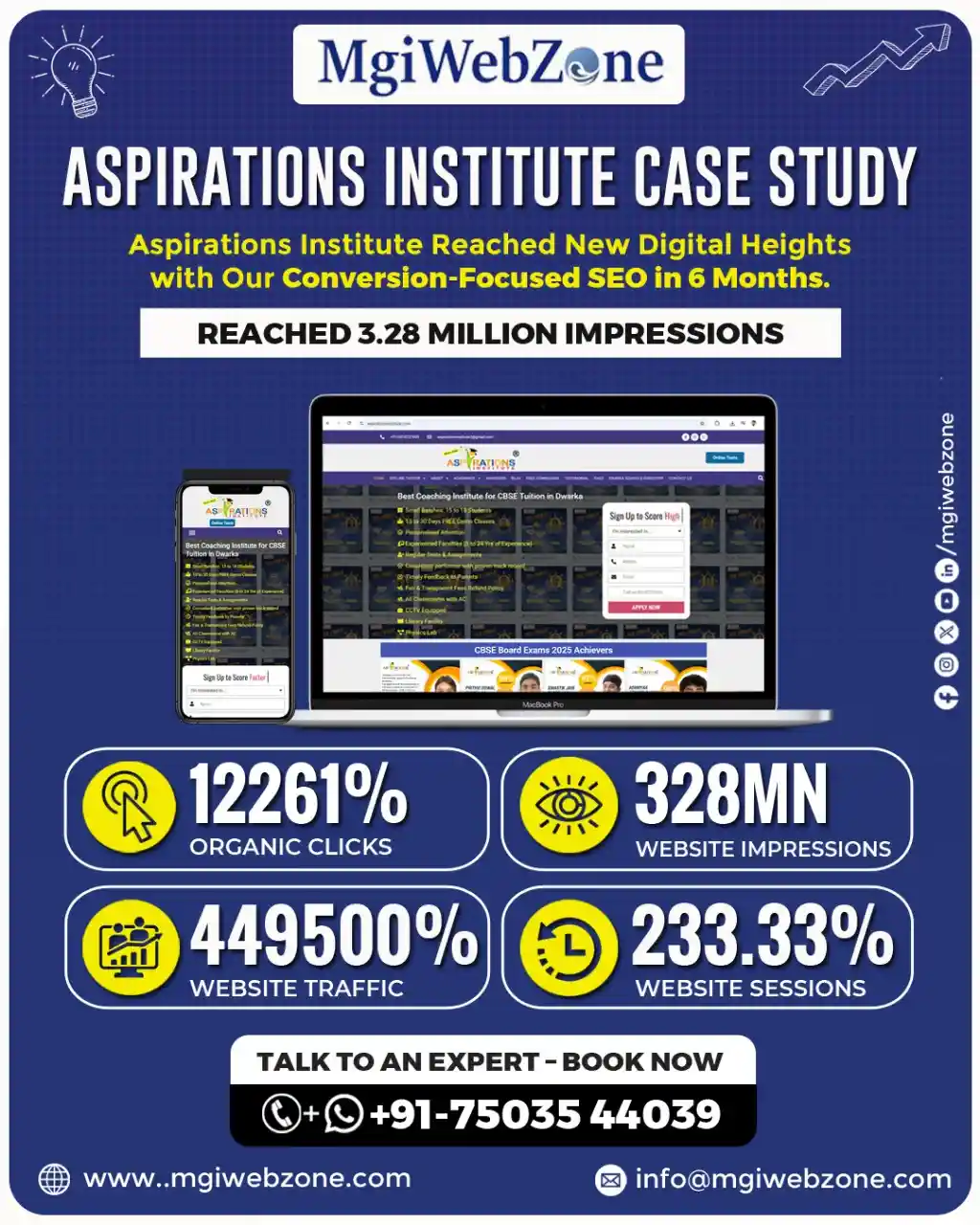
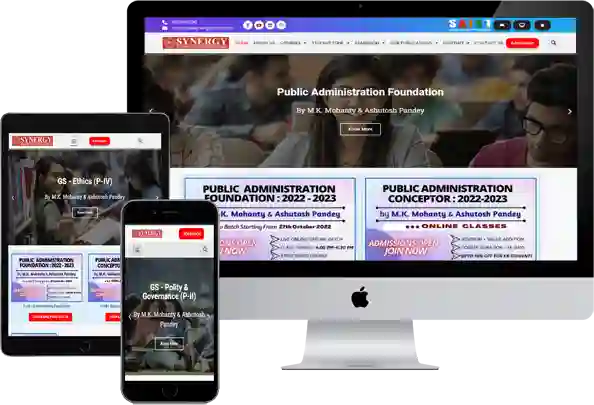
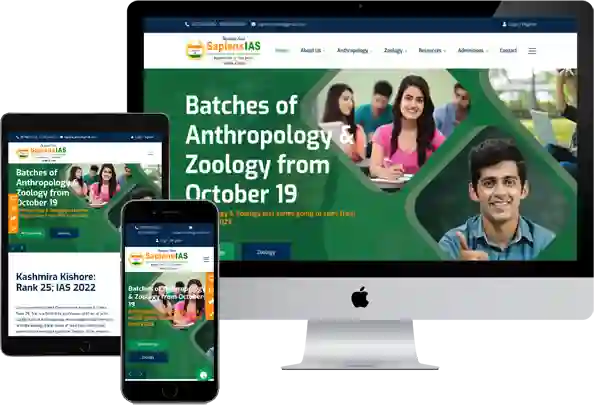
This shift is exactly what produced the results at Sapiens IAS, which reached 3.28 million impressions and 1,37,000 clicks through structured content and SEO — the vast majority from students who were not in Delhi. And at Synergy IAS, which generated 12,000 organic clicks in three months from aspirants searching across India, not just in the institute’s physical geography.
If the Market is So Large, Why Do Many Institutes Still Struggle?
Now here is the question worth sitting with. The market data in this article is unambiguous — demand is large, structural, and self-renewing. It compounds every year. It reaches students in every city, at every stage of preparation.
And yet the most common complaint from coaching institute owners is this: batches are not full despite good faculty and strong course quality.
That disconnect has one consistent explanation. The market exists. The students are searching. But the institute is simply not visible at the moment the decision is being made.
Common patterns behind this gap, seen consistently across institutes:
The website exists but ranks for nothing — no course-specific or subject-specific queries. Google Ads are running, but sending traffic to a general homepage that does not convert enquiries into calls. Competitor institutes appear above them in search results despite weaker course content.
No presence on AI platforms — when a student asks ChatGPT or Gemini for the best Sociology optional coaching, the institute’s name does not come up. Online reputation is thin — no Google reviews, no testimonials, no published content that signals expertise.
A student who cannot find an institute online does not know that it is the better option. They will call whoever appeared first. SEO for UPSC coaching institutes is the foundation for fixing this — creating the consistent organic presence that means the right students find the right institute before they find anyone else. And the real cost of working with the wrong marketing company often shows up precisely here: months or years of spend with no ranking, no enquiries, and no compounding benefit.
Proof That This Market Can Be Captured: What Structured Digital Work Delivers
At MgiWebzone, this is the problem we work on with every UPSC coaching client — GS institutes, optional subject coaching, test series providers, and interview coaching programmes. Across every engagement, the pattern is consistent. The market is there. The demand is real. The gap is always visible.
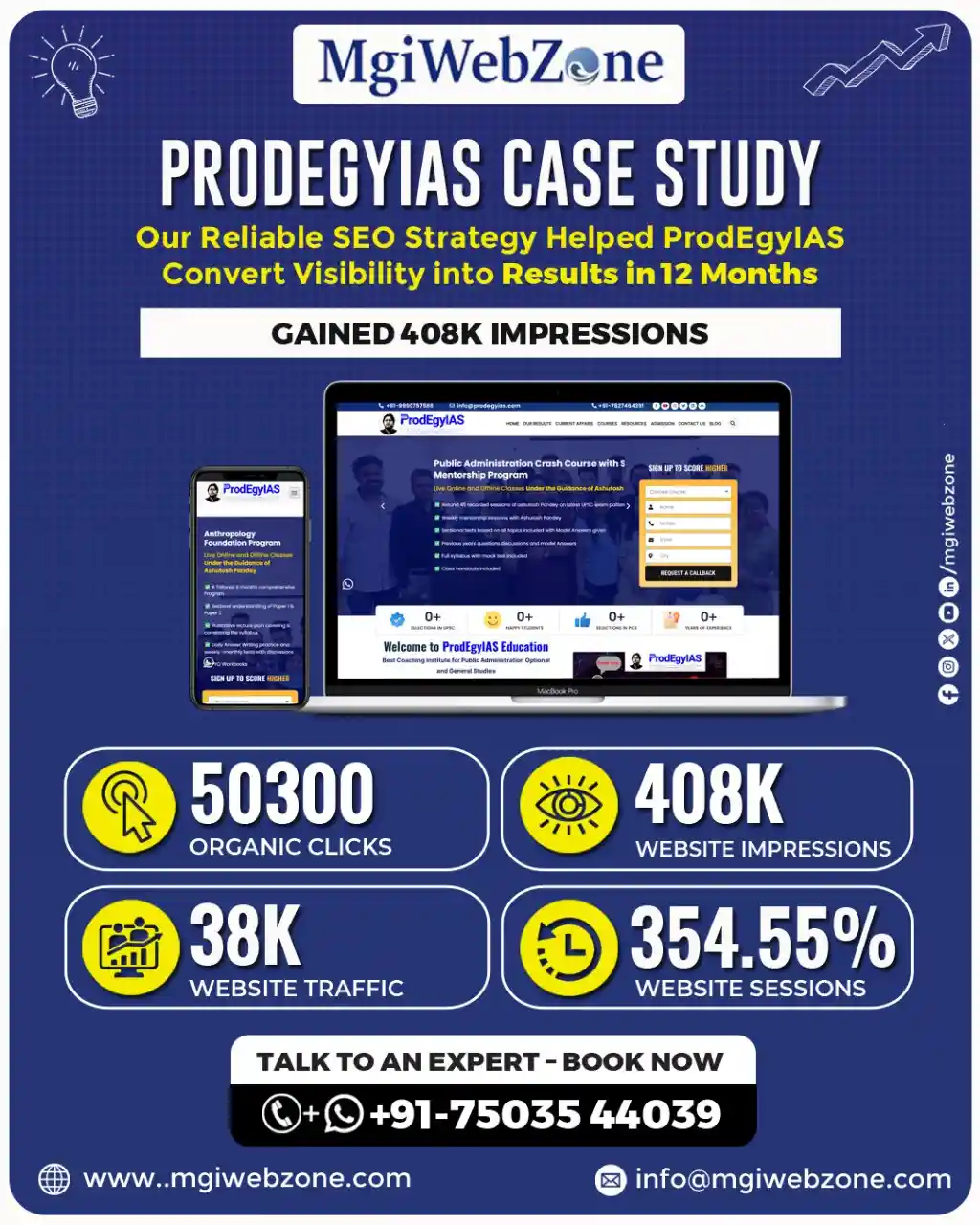
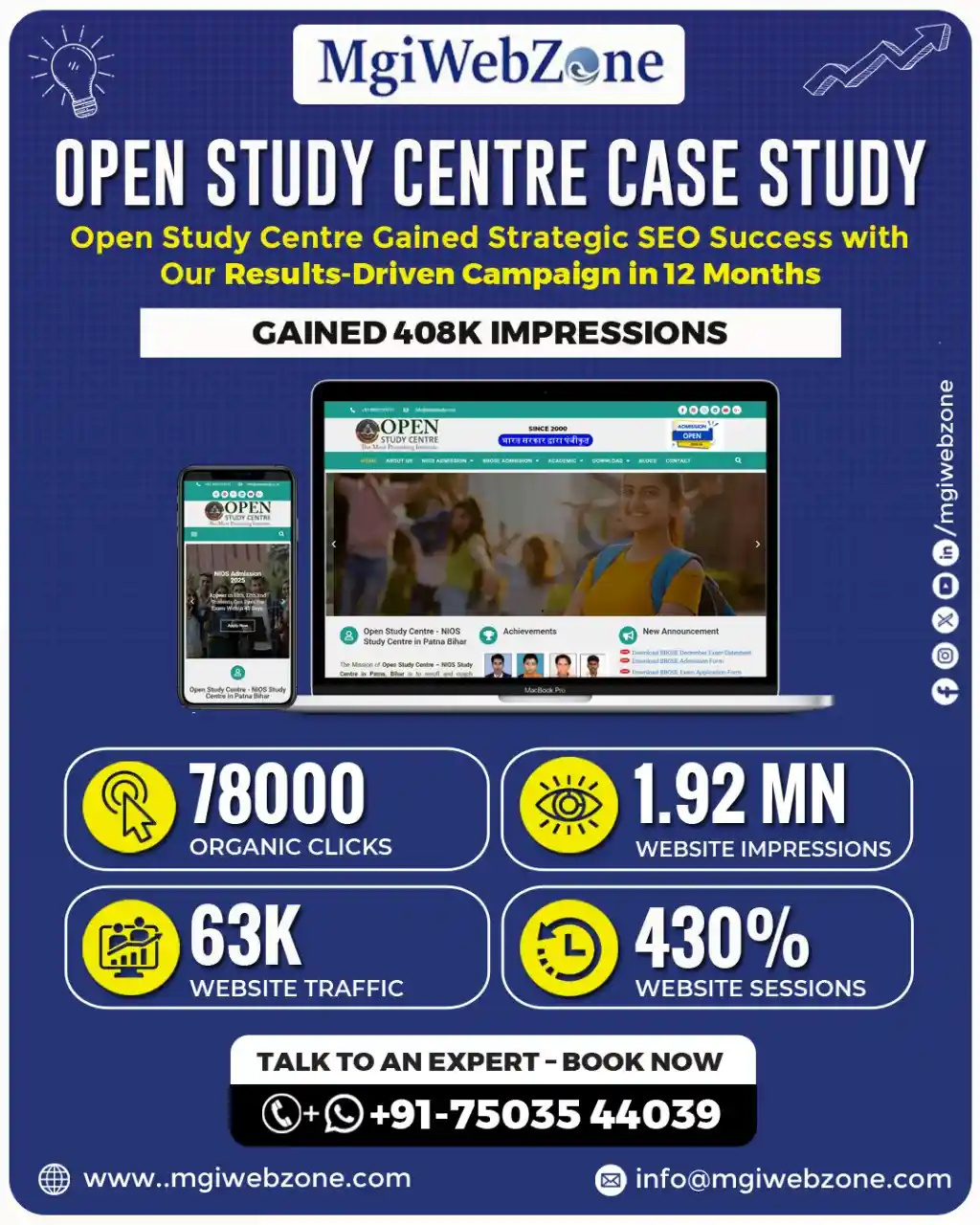
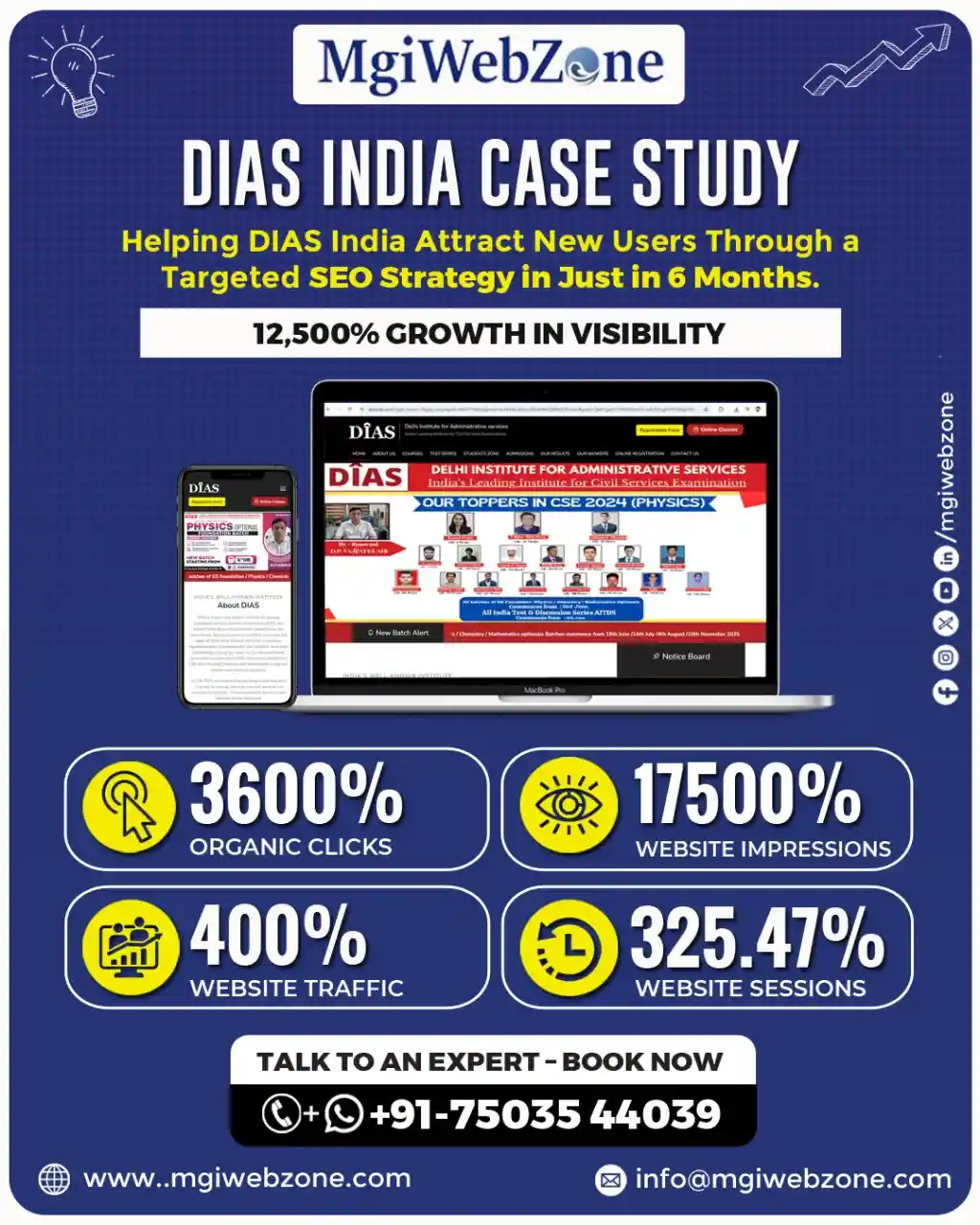
DIAS India came to us with strong content, experienced faculty, and no meaningful digital footprint. After structured SEO and content work, Google visibility grew by 12,500% and organic clicks grew by 3,600%. Sapiens IAS reached 3.28 million impressions and 1,37,000 clicks. Synergy IAS generated 12,000 organic clicks in three months. IMS4Maths reached 1.45 million impressions and 1,31,000 clicks. ProdEgy IAS generated 50,300 clicks and 4,08,000 impressions — all from aspirants who were already searching for what the institute offered.
In each case, the coaching quality was already there. The students were already searching. The only work was to make the institute visible at the exact moment of that search — on Google, on AI Overviews, on the platforms where preparation decisions actually happen.
This is not a theoretical market. It is a market where structured digital systems convert existing demand into enquiries and enrolments. How to choose the right digital marketing agency for your coaching institute is the first practical question — because the approach matters as much as the effort.
Frequently Asked Questions — UPSC Coaching Market in India (2026)
How big is the UPSC coaching market in India in 2026?
The total UPSC coaching market across all segments — GS Foundation, optional subject coaching, test series, Mains answer writing, and interview coaching — is estimated at ₹3,500 crore to ₹22,000 crore annually. This is a derived estimate based on UPSC participation data, observed fee ranges, and coaching participation rates. It is not an audited or officially published figure.
How many students appear in UPSC Prelims every year?
In CSE 2025, 5,76,793 students appeared in Prelims. In CSE 2024, 5,83,213 appeared. The average across 2019–2025 is approximately 5.5 to 6 lakh per year. The appearance rate hit 61.5% in CSE 2025 — the highest in the data set from 2007 to 2025. Source: UPSC Annual Reports (up to CSE 2021) and PIB press releases (CSE 2022–2025).
Why is the UPSC coaching market bigger than the yearly Prelims numbers suggest?
Three structural reasons. First, most candidates attempt multiple times — students from previous years are still in the coaching market. Second, many begin joining coaching classes two to four years before their first attempt — they do not show up in the exam funnel yet. Third, one aspirant typically join from multiple institutes across different preparation stages. The coaching market compounds. It does not reset each exam cycle.
How many students fail UPSC Prelims every year?
In CSE 2025, 5,76,793 students appeared and 14,161 qualified for Mains — meaning approximately 5,62,632 did not qualify. Across recent years, approximately 5.3 to 5.7 lakh students fail the Prelims annually. Source: UPSC official press release (CSE 2025) and UPSC Annual Reports.
How many students join optional subject coaching for UPSC?
An estimated 6 to 10 lakh students are at the Prelims preparation stage across all 26 optional subjects. Students commit to their optional early in preparation — often before clearing Prelims — so the real coaching pipeline is far larger than Mains optional participation numbers suggest. The most fragmented segment in UPSC coaching, with no single national brand dominating across all subjects. All figures are derived estimates from participation data and observed fee ranges.
Which optional subjects have the largest coaching demand in UPSC?
Based on post-2021 topper data and participation estimates, PSIR and Sociology currently lead. PSIR had both AIR 1 and AIR 2 in CSE 2024. Sociology had AIR 2, AIR 5, and AIR 10 in CSE 2025. Anthropology, Mathematics, and Medical Science also show strong recent demand signals. Official subject-wise participation data has not been published by UPSC for any year after CSE 2021 as of March 2026. For practical examples of how coaching institutes have grown in these segments, see the IMS4Maths case study.
How large is the UPSC Prelims test series market in India?
Approximately 4 to 5 lakh students join a Prelims test series annually — including new aspirants and returning repeat buyers. At fee ranges of ₹4,000 to ₹15,000 per student, the estimated market value is ₹160 crore to ₹750 crore per year. This market self-renews every exam cycle — new cohorts enter while 1.6 to 1.7 lakh returning aspirants actively switch providers after a failed attempt.
How many repeat aspirants enter the UPSC coaching market each year?
If only 30% of students who fail Prelims attempt again the following year, that represents 1.6 to 1.7 lakh returning aspirants actively looking for better coaching or a different test series. This pool renews every year without fail and is one of the most consistently profitable demand segments in the entire UPSC coaching ecosystem.
Is UPSC coaching a profitable business in India?
Yes — with structured marketing. The demand is structural and self-renewing. The challenge is not market size but digital visibility. Institutes that appear prominently when students search consistently fill batches despite strong competition. The 504:1 coaching-to-selection ratio means demand is always present. The work is to ensure the right students find the right institute first. Choosing the right digital partner for your coaching institute is where that work begins.
How can a UPSC coaching institute get more students online in 2026?
Through Google SEO — ranking for subject-specific, course-specific, and location-specific search queries. Through Google Ads — targeting high-intent searches from aspirants who are actively comparing options. Through content that answers the questions students are actually searching. And through visibility on AI platforms — ChatGPT, Gemini, Perplexity, and Google AI Overviews — where increasing numbers of aspirants now start their research. SEO for UPSC coaching institutes and Google Ads for UPSC coaching are the two primary channels to build.
How big is the UPSC coaching market in India in 2026?
The total UPSC coaching market across all segments — GS Foundation, optional subject coaching, test series, Mains answer writing, and interview coaching — is estimated at ₹3,500 crore to ₹22,000 crore annually. This is a derived estimate based on UPSC participation data, observed fee ranges, and coaching participation rates. It is not an audited or officially published figure.
How many students appear in UPSC Prelims every year?
In CSE 2025, 5,76,793 students appeared in Prelims. In CSE 2024, 5,83,213 appeared. The average across 2019–2025 is approximately 5.5 to 6 lakh per year. The appearance rate hit 61.5% in CSE 2025 — the highest in the data set from 2007 to 2025. Source: UPSC Annual Reports (up to CSE 2021) and PIB press releases (CSE 2022–2025).
Why is the UPSC coaching market bigger than the yearly Prelims numbers suggest?
Three structural reasons. First, most candidates attempt multiple times — students from previous years are still in the coaching market. Second, many begin joining coaching classes two to four years before their first attempt — they do not show up in the exam funnel yet. Third, one aspirant typically join from multiple institutes across different preparation stages. The coaching market compounds. It does not reset each exam cycle.
How many students fail UPSC Prelims every year?
In CSE 2025, 5,76,793 students appeared and 14,161 qualified for Mains — meaning approximately 5,62,632 did not qualify. Across recent years, approximately 5.3 to 5.7 lakh students fail the Prelims annually. Source: UPSC official press release (CSE 2025) and UPSC Annual Reports.
Conclusion: The UPSC Coaching Market is Bigger Than It Looks
The UPSC exam funnel shows 5.5 to 6 lakh serious aspirants appearing in Prelims each year. The real active coaching market is estimated at 15 to 25 lakh students at any given time. Six student segments — from early starters in Class 12 to repeat aspirants on their fourth attempt — buy seven distinct product categories across preparation journeys that span years. The total estimated market is ₹3,500 crore to ₹22,000 crore annually.
Optional subjects are not one market — they are 26 sub-markets, each responding to its own topper signals and demand cycles. Repeat aspirants self-renew the coaching revenue base every exam cycle without exception. And the geographic boundary of this market has expanded permanently — from the coaching lanes of Mukherjee Nagar to every city in India where a student has internet access and a UPSC aspiration.
The demand is not the question. The demand is documented.
The only question is whether the right student finds the right institute before they find someone else.
If you want to understand exactly where your institute stands right now — how many students are searching for what you offer, and whether your institute appears when those searches happen — one conversation is enough to show you the full picture. Call or WhatsApp: +91-7503544039.
Data-driven Digital Marketing Results for UPSC/IAS Coaching Institutes
Share this :

MgiWebzone
Passionate about SEO, content, and everything that helps businesses grow online.
Read All Post
Content Marketing for UPSC Coaching — Building Trust Before the Aspirant Even Calls
Popular Categories
How Can We Help?
Discover tailored solutions to grow your business and achieve lasting success.
Our Service
Our Latest Post






FOLLOW US ON
Facebook
Twitter
LinkedIn
Pinterest
WhatsApp
Skype
SEO Insights, Tips & Trends from Our Blog
Why Your Coaching Institute’s Website Doesn’t Show Up When a Student Asks Google’s AI
Is Your Coaching Institute Visible on AI? AI Search Visibility More Student Enquiries ChatGPT & Gemini Ready AEO

Performance Marketing for Educational Institutes: A Complete Guide to Getting More Admissions in 2026
Scale Educational Admissions Using Performance Marketing Strategies Targeted Student Lead Generation Data-Driven Campaign Optimization High-Converting Ad Creatives Multi-Channel
Lead Generation for Coaching Institutes: Complete Data-Driven Guide (SEO, Ads, AI & Student Enrollment Strategy)
Fill Your Coaching Batches with Predictable Leads Data-driven student acquisition strategy SEO, Ads & AI combined High-intent enquiries,
Indian Education Marketing Statistics Report 2026: SEO, PPC, AI, Lead Generation & ROI Trends
Indian Education Marketing Stats 2026 Every Institute Owner Must Know Real Data on Student Search Behaviour SEO, PPC
Website Design for Coaching Institutes and Education Institutes in India — The Complete Guide (2026 Edition)
Your Coaching Website is Not a Brochure — It’s Your Admission Engine Why Coaching Websites Fail to Convert
UPSC Optional Subject Coaching Market Report 2026: Complete Data on All 25 Subjects, Market Size, Toppers, and Trends
UPSC Optional Coaching Market Report Every Institute Owner Must Read Real Market Size Behind Each Subject 25 Subjects
Trusted and Affordable Digital Marketing Company in Delhi, India
- Latest Marketing Strategy
- Affordable Service Packages
- Improve User Experience
- Quality & Organic Traffic
- Transparent Progress Report
- Certified Professionals Expertise
Request a Quote
5/5 - (3 votes)


