

UPSC Optional Coaching Market Report Every Institute Owner Must Read
- Real Market Size Behind Each Subject
- 25 Subjects Create 25 Separate Markets
- Top Subjects Dominate Coaching Revenue
- Small Subjects Have High ROI Potential
- Top-10 Topper Analysis — 2013 to 2025
- Where Coaching Institutes Should Focus
Request a Quote
UPSC Optional Subject Coaching Market Report 2026: Complete Data on All 25 Subjects, Market Size, Toppers, and Trends

In CSE 2025, 5,76,793 students appeared for UPSC Prelims. Only 1,087 seats were available. On 6 March 2026, when UPSC declared the results, Anuj Agnihotri — an MBBS graduate from AIIMS Jodhpur — stood at AIR 1 with Medical Science as his optional subject, scoring 1,105 out of 2025 total marks in his third attempt. It was the first time in the single-optional era that a Medical Science candidate topped the entire country.
Every one of those 5.76 lakh students had to choose an optional subject. Most of them were enrolled in optional coaching before they even sat the exam. That is the market your coaching institute operates in.
This report covers all 25 general optional subjects with official participation data from the single-optional era (2014 to 2021), directional estimates for 2022 to 2025, coaching market size calculations, verified top-10 topper records from CSE 2013 to 2025, and a plain breakdown of what all of it means for your digital presence and admissions strategy.
One non-negotiable note before we begin — please read this first.
UPSC completely restructured the Civil Services Examination in 2013. Before CSE 2013, every Mains candidate chose two optional subjects. From CSE 2013 onward, only one optional is allowed.
This means the 2012 data in this report reflects a fundamentally different exam format — where the same student could choose Geography as one optional and Public Administration as the second. Every subject’s 2012 count includes both primary and secondary optional demand, making the total optional appearances across all subjects roughly twice the total Mains candidates.
It is therefore factually incorrect to compare any subject’s 2012 figure with its 2021 figure and call the difference “growth” or “decline.” Such comparisons mix two incompatible data sets.
All trend analysis, growth comparisons, and market narratives in this report use CSE 2014 as the earliest reference year — the first fully comparable single-optional data year. Where 2012 figures appear in the master table, they are clearly labelled as pre-reform reference data and must not be used in any percentage calculation.
Table of Contents
Which UPSC Optional Subjects Look Strongest for Coaching Institutes in 2026?
Sociology, PSIR, and Anthropology together held 27 of 40 top-10 positions across CSE 2022 to 2025. But the full picture includes market size, success rates, topper momentum, and digital competition signals. Here is the complete quick answer.
Key UPSC Optional Subject Findings — 2025 Summary
- PSIR is the largest optional coaching market in India — estimated 72,400–77,900 students at the Prelims stage. Within the single-optional era, PSIR grew from 907 Mains candidates (2014) to 1,571 (2021) — a 73% increase. Peak: 1,863 in CSE 2020 — a 105% rise from the 2014 baseline. Two AIR 1s in three years: Ishita Kishore (CSE 2022) and Shakti Dubey (CSE 2024). Only optional in top-10 in all 4 post-2021 exam cycles.
- Anthropology grew from 619 Mains candidates (2014) to 1,159 (2021) — an 87% increase in the single-optional era, with a peak of 1,211 in 2020 (+96%). Five of ten top-10 rankers chose Anthropology in CSE 2022 — the single highest concentration by any subject in any year. Estimated market: approximately 44,000–47,000 students.
- Sociology produced 11 top-10 appearances across CSE 2022–2025 — most of any subject. Back-to-back AIR 2 results: Animesh Pradhan (CSE 2023, first attempt) and Rajeshwari Suve M (CSE 2025). Estimated coaching market approximately 61,600–66,200 students. Note: Sociology declined in absolute Mains numbers within the single-optional era (1,819 in 2014 to 1,087 in 2021) but is now growing strongly based on post-2021 topper signals.
- Medical Science made history. Anuj Agnihotri (AIR 1, CSE 2025, AIIMS Jodhpur, 3rd attempt) scored 1,105/2025 total — equalling Shruti Sharma’s 2021 score, the joint-highest in available verified data. This is the first Medical Science AIR 1 in the single-optional era. Success rate: 10.7–12.2%. Coaching demand from the MBBS community is building fast.
- Electrical Engineering produced Aditya Srivastava AIR 1 (CSE 2023) — an IIT Kanpur graduate who scored 308/500 in Electrical Engineering optional. His result nearly doubled the coaching market for this subject. The digital marketing opportunity for Electrical Engineering optional coaching is still largely uncaptured.
- Mathematics had the single most impactful optional score in UPSC history — Kanishak Kataria’s 361/500 (AIR 1, CSE 2018) — and grew from 351 (2014) to 513 (2021) in the single-optional era, a 46% increase. Consistently the highest-fee optional coaching market.
- Commerce & Accountancy has a 15% success rate and two top-3 results in three years. Garima Lohia AIR 2 (CSE 2022) and Akansh Dhull AIR 3 (CSE 2025). Two top-3 results in three years from under 140 Mains candidates.
Sociology + PSIR + Anthropology combined: 27 of 40 top-10 positions from 2022–2025 — 67.5% of all elite results in the post-2021 era.
Data-driven Digital Marketing Results for UPSC/IAS Coaching Institutes
What This UPSC Optional Subject Report Covers — and How to Read the Data
What is Included in This UPSC Optional Subject Report?
Six layers of data: the UPSC exam funnel from 2012 to 2025, official optional subject Mains participation from the single-optional era (2014 to 2021), directional estimates for 2022 to 2025, coaching market size calculations for all 25 subjects, verified top-10 topper data from CSE 2013 to 2025, and subject-by-subject coaching and digital marketing intelligence.
This is the only publicly available report that combines all of these data points in one place — with explicit data confidence labels and a rigorous single-optional era methodology applied consistently to every figure.
What is Official UPSC Data and What is an Estimate?
1) Official data — from UPSC Annual Reports (58th to 73rd): single-optional era subject-wise Mains participation for CSE 2014, 2015, 2016, 2017, 2019, 2020, and 2021. Cited as confirmed fact throughout. CSE 2013 and 2018 data not available.
2) Pre-reform reference data (2012) — included in the master table for historical context only. Not used in any trend percentage or market calculation.
3) Directional estimates — CSE 2022 to 2025 subject-level participation is not officially published. Estimates are based on topper signals and trends. Always labelled “approximately” or “estimated.”
4) Verified topper data — top-10 optional subject data for CSE 2022 to 2025 is confirmed from official UPSC merit lists and PIB press releases.
Find Out How Many Students Are Already Searching for Your Coaching Institute
Get a free visibility check. No commitment. Just clarity.
How Competitive is UPSC Right Now? The Market Every Coaching Institute is Fighting For
How Many Students Actually Appear for UPSC Prelims Each Year?
Application numbers are misleading. Between 38% and 59% of applicants have not shown up on exam day in various years. What matters for coaching institutes is the appeared count — these are the committed students actively searching for optional coaching.
UPSC CSE Exam Funnel — Select Years
CSE Year | Prelims Appeared | Mains Appeared | Finally Selected | Success Rate | 1-in-X Ratio | Appearance Rate |
2014 | 4,46,623 | 16,286 | 1,236 | 0.28% | 1 in 361 | 47.1% |
2017 | 4,56,625 | 13,060 | 1,056 | 0.23% | 1 in 432 | 47.1% |
2019 | 5,68,282 | 11,474 | 829 | 0.15% | 1 in 686 | 50.0% |
2021 | 5,08,619 | 8,930 | 748 | 0.15% | 1 in 680 | 45.7% |
2022 | 5,73,735 | ~12,775 | 933 | 0.16% | 1 in 615 | 50.5% |
2023 | ~6,00,000 | ~13,090 | 1,016 | ~0.17% | ~1 in 591 | ~54.9% est. |
2024 | 5,83,213 | ~14,627 | 1,009 | ~0.17% | ~1 in 578 | 58.8% |
2025 | 5,76,793 | ~14,161 | 1,087 | 0.19% | 1 in 530 | 61.5% |
(Source: CSE 2014–2021: UPSC Annual Reports. CSE 2022–2025: PIB Press Releases. 2023 figure estimated. 2025 includes a reserve list).
Notice one crucial pattern: Mains dropped from 16,286 (CSE 2014) to 8,930 (CSE 2021) — a 45% reduction in the total Mains pool. This is an essential context for understanding optional subject participation trends. Any subject that maintained its absolute candidate count during this period actually grew its market share significantly.
The CSE 2025 appearance rate of 61.5% is the highest in the entire dataset going back to 2007. The pool of serious, committed candidates is growing — very good news for coaching institutes and for lead generation strategies targeting UPSC aspirants.
What Are the Real Odds of Clearing UPSC?
Era-by-era: 0.44% average (2007–2011) → 0.26% (2012–2016) → 0.15% (2017–2021, historic low) → 0.19% (CSE 2025, best modern-era rate).
In CSE 2021, a candidate was 1 in 680. In CSE 2025, 1 in 530. Every serious aspirant knows they need structured optional coaching. The only question they are asking is which institute deserves their trust.
How Big is the Total UPSC Coaching Market Right Now?
Approximately 5,76,793 Prelims appeared (CSE 2025) × 65% coaching participation rate = approximately 3.75 lakh active UPSC coaching students in a single exam cycle. Every single one of them is in the market for optional coaching.
The demand is confirmed by official data. The institutes that appear in online searches are filling batches. The ones that do not appear are watching the same students enrol somewhere else.
Your Coaching Niche Has a Market. Let's Make Sure Students Can Find You.
MgiWebzone builds AI-ready SEO strategies specifically for UPSC coaching institutes.
Why UPSC Optional Subject Data Matters More Than Most Coaching Owners Realise
Why the UPSC Optional Coaching Market is Always Much Larger Than Mains Participation
Students choose their optional subject and join coaching during Prelims preparation — typically 12 to 18 months before they ever sit Mains. By the time they appear in Mains, they have already paid fees and completed most of their preparation. The Mains count is not your market. It is your market after it has already made decisions.
Formula: (Subject’s Mains Candidates ÷ Total Mains Candidates) × (Total Prelims Appeared × 95%) = Estimated Coaching Market
The 95% factor removes casual test-takers. The result is always 40 to 55 times larger than the Mains count.
Example: PSIR had 1,571 Mains candidates in CSE 2021. Estimated coaching market at Prelims stage: approximately 72,400–77,900 students — not 1,571. That is the scale of the actual marketing opportunity.
Why UPSC Topper Stories Move Optional Coaching Markets
1) Anudeep Durishetty, AIR 1, CSE 2017, Anthropology, 4th attempt. Mains participation rose from 619 (2014 baseline) to 1,211 (2020) — a 96% increase from the single-optional era baseline. Strongest documented AIR-1 market effect in UPSC history.
2) Kanishak Kataria, AIR 1, CSE 2018, Mathematics. His 361/500 — the all-time highest optional score in UPSC history — triggered a surge in IIT and engineering graduates choosing Mathematics. Participation grew from 351 (2014) to 580 (2020), a 65% rise from the single-optional era baseline.
3) Aditya Srivastava, AIR 1, CSE 2023, Electrical Engineering, IIT Kanpur. Scored 308/500 in Electrical Engineering optional. His result nearly doubled the coaching demand for this subject almost overnight. The digital marketing opportunity for Electrical Engineering optional coaching is still largely uncaptured in 2026.
4) Anuj Agnihotri, AIR 1, CSE 2025, Medical Science, AIIMS Jodhpur. Scored 1,105/2025 total marks in his third attempt — equalling Shruti Sharma’s 2021 score, the joint-highest total in available verified data. The MBBS community is watching. Lead generation for Medical Science optional coaching institutes is early-stage and almost unchallenged.
Discover How Our Expert Solutions Can Elevate Your Online Presence
- Boost Online Visibility Fast
- Get More Quality Leads
- Rank Higher on Google
All 25 UPSC Optional Subjects — Single-Optional Era Participation Data (2014–2021)
About This UPSC Data — Official, Pre-Reform, and Estimated Figures Explained
The table below covers the single-optional era (2014 to 2021) as the primary data for all analysis. The 2012 column is included for historical reference only and is clearly labelled as pre-reform data. It must not be used for any trend, percentage, or market calculation.
UPSC Optional Subject Mains Participation Master Table (2014–2021 Official Data)
Subject | 2012 PRE-REFORM | 2014 | 2015 | 2016 | 2017 | 2019 | 2020 | 2021 | 2022 Est. | 2023 Est. | 2024 Est. | 2025 Est. | Trend (2014–2021) |
PSIR | 1,107 | 907 | 989 | 1,218 | 1,246 | 1,662 | 1,863 | 1,571 | ~1,800 | ~1,900 | ~2,000 | ~2,000 | ↑ Rising +73% |
Anthropology | 579 | 619 | 641 | 922 | 880 | 1,189 | 1,211 | 1,159 | ~1,400 | ~1,300 | ~1,200 | ~1,200 | ↑ Rising +87% |
Mathematics | 325 | 351 | 258 | 406 | 441 | 478 | 580 | 513 | ~520 | ~540 | ~550 | ~560 | ↑ Rising +46% |
Sociology | 2,490 | 1,819 | 1,479 | 1,635 | 1,421 | 1,263 | 1,245 | 1,087 | ~1,200 | ~1,350 | ~1,500 | ~1,700 | ↓ Declining -40% (recovering post-2021) |
Geography | 4,351 | 3,515 | 3,391 | 3,427 | 2,669 | 1,916 | 1,322 | 1,079 | ~1,000 | ~950 | ~900 | ~870 | ↓ Declining -69% |
History | 2,090 | 1,560 | 1,821 | 1,427 | 1,074 | 751 | 581 | 574 | ~590 | ~620 | ~650 | ~640 | ↓ Declining -63% (stabilising) |
Public Admin | 7,077 | 2,852 | 1,795 | 1,506 | 1,165 | 705 | 509 | 361 | ~350 | ~320 | ~290 | ~265 | ↓ Declining -87% |
Philosophy | 1,116 | 908 | 847 | 847 | 755 | 439 | 347 | 265 | ~270 | ~280 | ~285 | ~290 | ↓ Declining -71% |
Medical Science | 322 | 356 | 327 | 368 | 313 | 247 | 162 | 196 | ~210 | ~230 | ~250 | ~280 | ↓ Declining then ↑ Surging post-2025 |
Economics | 269 | 214 | 185 | 232 | 233 | 243 | 236 | 190 | ~200 | ~200 | ~200 | ~205 | → Stable -11% |
Commerce & Acc | 188 | 214 | 152 | 229 | 224 | 183 | 210 | 140 | ~160 | ~185 | ~210 | ~240 | → Stable, recovering post-2022 |
Law | 246 | 235 | 245 | 313 | 304 | 186 | 167 | 180 | ~185 | ~185 | ~188 | ~190 | → Stable -23% |
Psychology | 1,163 | 373 | 238 | 244 | 193 | 164 | 155 | 127 | ~122 | ~118 | ~115 | ~112 | ↓ Declining -66% |
Elec. Engineering | ~126 | ~192 | ~143 | ~190 | ~193 | ~200 | ~170 | ~117 | ~130 | ~160 | ~200 | ~250 | → Stable / ↑ Surging post-2023 |
Physics | ~266 | 198 | 165 | 187 | 168 | 152 | 140 | 131 | ~135 | ~138 | ~140 | ~142 | ↓ Declining -34% (stabilising) |
Chemistry | ~175 | 192 | 169 | 165 | 148 | 145 | 135 | 127 | ~125 | ~122 | ~120 | ~120 | ↓ Declining -34% |
Zoology | 83 | 89 | 77 | 63 | 56 | 57 | 55 | 56 | ~57 | ~58 | ~58 | ~58 | → Stable -37% |
Agriculture | 186 | 202 | 171 | 183 | 157 | 132 | 130 | 115 | ~110 | ~108 | ~105 | ~102 | ↓ Declining -43% |
Civil Engineering | ~147 | ~183 | ~153 | ~160 | ~126 | ~103 | ~101 | ~100 | ~102 | ~105 | ~108 | ~110 | → Stable -45% |
Mech. Engineering | ~128 | ~138 | ~107 | ~112 | ~97 | ~82 | ~79 | ~80 | ~80 | ~82 | ~83 | ~84 | → Stable -42% |
Management | 43 | 54 | 45 | 44 | 46 | 38 | 32 | 31 | ~29 | ~28 | ~27 | ~26 | → Stable -43% |
Botany | 46 | 47 | 38 | 35 | 34 | 32 | 31 | 32 | ~32 | ~32 | ~33 | ~33 | → Stable -32% |
Geology | ~38 | 42 | 36 | 35 | 30 | 27 | 27 | 29 | ~29 | ~29 | ~30 | ~30 | → Stable -31% |
Animal Husbandry | 22 | 28 | 21 | 18 | 19 | 17 | 17 | 18 | ~18 | ~18 | ~18 | ~18 | → Stable -36% |
Statistics | 7 | 4 | 5 | 6 | 5 | 4 | 4 | 3 | ~4 | ~3 | ~3 | ~4 | → Stable |
(Source: UPSC Annual Reports 58th–73rd. CSE 2013 and 2018 data not available in extractable format. The 2012 column is PRE-REFORM, TWO-OPTIONAL ERA — included for historical reference only. Under that format, each candidate chose two subjects, so 2012 figures reflect combined first + second optional demand and are NOT comparable with any single-optional era figure. They must never be cited as a starting point for any trend, percentage, or growth calculation. CSE 2022–2025 columns are directional projections — NOT official UPSC data).
Trend classification (single-optional era, 2014–2021):
- Rising ↑ — PSIR (+73%) | Anthropology (+87%) | Mathematics (+46%)
- Stable / Surging post-result →↑ — Economics | Law | Commerce & Accountancy | Electrical Engineering (surging post-2023) | Medical Science (surging post-2025) | Civil Engineering | Mechanical Engineering | Management | Botany | Geology | Animal Husbandry | Statistics | Zoology
- Declining ↓ — Sociology (-40%, now recovering) | Geography (-69%) | History (-63%, stabilising) | Public Administration (-87%) | Philosophy (-71%) | Psychology (-66%) | Physics (-34%) | Chemistry (-34%) | Agriculture (-43%)
Which UPSC Optional Subject Was Most Popular Each Year? (Single-Optional Era: 2014–2021)
Year-wise Top 5 UPSC Optional Subjects by Mains Participation — Single-Optional Era Only
Year | Rank 1 | Rank 2 | Rank 3 | Rank 4 | Rank 5 |
2014 | Geography (3,515) | Public Admin (2,852) | Sociology (1,819) | History (1,560) | Philosophy (908) |
2015 | Geography (3,391) | History (1,821) | Public Admin (1,795) | Sociology (1,479) | PSIR (989) |
2016 | Geography (3,427) | Sociology (1,635) | Public Admin (1,506) | History (1,427) | PSIR (1,218) |
2017 | Geography (2,669) | Sociology (1,421) | PSIR (1,246) | Public Admin (1,165) | History (1,074) |
2019 | Geography (1,916) | PSIR (1,662) | Sociology (1,263) | Anthropology (1,189) | History (751) |
2020 | PSIR (1,863) | Geography (1,322) | Sociology (1,245) | Anthropology (1,211) | History (581) |
2021 | PSIR (1,571) | Anthropology (1,159) | Sociology (1,087) | Geography (1,079) | History (574) |
(Source: UPSC Annual Reports. These figures are for single-optional era only — 2012 two-optional era data is excluded).
In the single-optional era, Geography held Rank 1 from 2014 through 2019 — six consecutive years. PSIR overtook it in 2020 and held the top position through 2021. Public Administration held Rank 2 only in 2014 before falling to Rank 3 in 2015, Rank 4 in 2017, and outside the top 5 entirely by 2019.
This is an important correction from many published analyses that mistakenly use 2012 two-optional era data to claim Public Administration was the dominant subject for years. In the single-optional era, Geography was the dominant subject — and PSIR is the current dominant subject.
Tired of paying for ad traffic that never enquires?
MgiWebzone builds UPSC-specific campaigns targeting aspirants by subject, city, and exam preparation stage.
Which UPSC Optional Subjects Are Growing, Stable, or Declining?
The critical lens for this section: the total Mains pool dropped from 16,286 candidates (CSE 2014) to 8,930 (CSE 2021) — a 45% reduction. Any subject that merely declined in absolute numbers may have still maintained or grown its market share. Only subjects that grew in absolute numbers against a shrinking pool are genuinely growing.
Three UPSC Optional Subjects That Grew Unambiguously in the Single-Optional Era
Optional Subjects That Grew in Absolute Numbers (2014–2021, Single-Optional Era)
Subject | 2014 Mains Candidates | 2021 Mains Candidates | Single-Era Change | Market Share 2014 | Market Share 2021 |
PSIR | 907 | 1,571 | +73% | 5.6% | 17.6% |
Anthropology | 619 | 1,159 | +87% | 3.8% | 13.0% |
Mathematics | 351 | 513 | +46% | 2.2% | 5.7% |
(Source: UPSC Annual Reports — single-optional era data only. 2014 is the single-optional era baseline).
These three grew in raw candidate numbers AND market share simultaneously — even as the total Mains pool shrank by 45%. That is the only valid definition of structural growth in this dataset.
PSIR’s market share more than tripled. Anthropology’s nearly quadrupled. Mathematics nearly tripled. No other optional subject achieved comparable growth in both absolute and market-share terms within the single-optional era.
Simple reason is — topper stories drove every single one of these growth trajectories. Anudeep Durishetty’s 2017 AIR 1 for Anthropology. Kanishak Kataria’s 2018 AIR 1 for Mathematics. Ishita Kishore’s 2022 AIR 1 and the sustained topper dominance for PSIR. Each result created demand that fed directly into coaching enrolments.
UPSC Sociology Optional — The Subject That Requires the Most Careful Data Reading
This is where many published analyses get it wrong — and where using 2012 two-optional era data as a baseline creates a completely false picture.
Sociology had 1,819 Mains candidates in CSE 2014 (single-optional era baseline). By CSE 2021, that was 1,087 — a 40% decline in the single-optional era. Sociology’s absolute Mains count fell, not grew, during the single-optional era.
But — and this matters enormously — the total Mains pool fell by 45% in the same period. Sociology’s market share moved from 11.2% (2014) to 12.2% (2021). It actually held its proportional position even as its absolute count fell.
And then came the post-2021 signal: 11 top-10 appearances across CSE 2022 to 2025, back-to-back AIR 2 results in 2023 and 2025, four consecutive top-10 positions in CSE 2024. Estimated participation growing from ~1,200 (2022) to ~1,700+ (2025 est.). Sociology was declining in the single-optional era but is clearly growing now. Any coaching institute investing in SEO and content marketing for Sociology optional should act on the post-2021 momentum, not the single-era absolute count.
UPSC Optional Subjects That Have Declined — What the Data Actually Shows
Optional Subjects That Declined (2014→2021, Single-Optional Era)
Subject | 2014 Mains | 2021 Mains | Single-Era Change | Market Share 2014 | Market Share 2021 |
Geography | 3,515 | 1,079 | -69% | 21.6% | 12.1% |
Public Admin | 2,852 | 361 | -87% | 17.5% | 4.0% |
History | 1,560 | 574 | -63% | 9.6% | 6.4% |
Philosophy | 908 | 265 | -71% | 5.6% | 3.0% |
Psychology | 373 | 127 | -66% | 2.3% | 1.4% |
(Source: UPSC Annual Reports — single-optional era baseline only)
All five declined in both absolute numbers and market share — genuine structural decline.
Public Administration deserves a specific note. The single-optional era decline of -87% (2,852 in 2014 to 361 in 2021) is the most dramatic structural fall of any optional subject in this dataset.
Note: some analyses quote this as “97% decline from 2012” — that figure uses the pre-reform two-optional era count as the baseline, which is incorrect. The correct single-optional era decline is -87%, still the most severe of any subject.
Estimated coaching market for Public Administration: approximately 9,600–10,300 students at the 2025 estimated level as participation continues to fall. This is not 19,500 as some older analyses suggest — that figure uses incorrect formula inputs.
Psychology declined from 373 (2014) to 127 (2021) — a 66% fall. Some analyses cite “86% decline from 2012” — this misrepresents the data. The 2012 figure of 1,163 includes Psychology as a secondary optional choice under the two-optional format. The genuine single-optional era decline is 66%.
History shows signs of stabilising. The 2019–2021 range (574–751) suggests a floor. Three top-10 appearances in the post-2021 period (AIR 1 in CSE 2021, AIR 9 in CSE 2023, AIR 9 in CSE 2024) — the strongest post-2021 run in History’s single-optional era history — suggest mild recovery.
Two UPSC Optional Coaching Markets Surging Right Now — Electrical Engineering and Medical Science
- Electrical Engineering had ~192 Mains candidates in 2014 — a meaningful, mid-sized niche. By 2021, that fell to ~117 (-39%). Then Aditya Srivastava won AIR 1 in CSE 2023 with Electrical Engineering, scoring 308/500 from IIT Kanpur. Estimated participation growing sharply post-2023, with ~250 Mains candidates estimated for 2025. This is the clearest current example of a topper result triggering rapid market expansion.
- Medical Science had 356 Mains candidates in 2014, declining to 196 by 2021 (-45%). Then Anuj Agnihotri won AIR 1 in CSE 2025 with Medical Science, scoring 1,105/2025 total in his third attempt. This is a confirmed inflection point — the first Medical Science AIR 1 in the single-optional era signals a demand surge for the 2026+ coaching cycle.
UPSC Language Literature Optional Subjects — A Geographically Defined Coaching Market
Language literature optionals attract a specific, regionally concentrated audience. These are coaching markets where local SEO for coaching institutes and state-specific content marketing work especially well.
UPSC Language Literature Optional — Mains Participation
Subject | 2014 | 2015 | 2016 | 2017 | 2018 | 2019 | 2020 | 2021 | 2022 |
Hindi Literature | 403 | 421 | 283 | 265 | 234 | 187 | 223 | 207 | 285 |
Kannada Literature | 131 | 116 | 154 | 114 | 79 | 123 | 82 | 59 | 76 |
Malayalam Literature | 65 | 65 | 90 | 111 | 85 | 105 | 93 | 72 | 104 |
Tamil Literature | 94 | 93 | 115 | 106 | 70 | 77 | 63 | 27 | 33 |
Telugu Literature | 122 | 132 | 112 | 72 | 53 | — | — | — | — |
Gujarati Literature | 87 | 108 | 131 | 100 | 91 | 82 | 48 | 31 | 43 |
Punjabi Literature | — | — | — | — | — | — | — | — | — |
English Literature | 21 | 21 | 21 | — | — | 22 | — | — | 53 |
(Source: UPSC Annual Report appendices (2014–2022). All data belongs to the single-optional era; however, some entries were not available in extractable format for specific years).
Three topper highlights:
- Nandini KR (AIR 1, CSE 2016, Kannada Literature — only language literature AIR 1 in the single-optional era),
- Renu Raj (AIR 2, CSE 2014, Malayalam Literature),
- Jasmeet Singh Sandhu (AIR 3, CSE 2015, Punjabi Literature).
Regional language optional coaching institutes that build a strong state-level digital presence face almost no national competition.
How Big is the UPSC Optional Coaching Market for Each Subject? All 25 Subjects at a Glance
How is the UPSC Optional Subject Coaching Market Size Calculated?
Formula: (Subject’s Mains Candidates ÷ Total Mains Candidates) × (Total Prelims Appeared × 95%) = Estimated Coaching Market.
The 95% factor removes casual test-takers. All market size figures use CSE 2021 as the official data base year (single-optional era). The 2012 pre-reform figure is never used in any market calculation.
This number is always 40 to 55 times larger than the Mains count — because students join optional coaching 12–18 months before Mains. All figures below are MgiWebzone estimates derived from official UPSC data. Not published by UPSC.
UPSC Optional Subject Coaching Market Table — All 25 Subjects (2025 Estimates)
UPSC Optional Subject Coaching Market — Estimates
Subject | Stars | 2021 Mains (Official) | 2025 Est. Coaching Market | Typical Fee Range | Market Category | Success Rate 2021 |
PSIR | ★★★★★ | 1,571 | ~72,400–77,900 | ₹20,000–₹70,000 | Very Large | 8.2% |
Sociology | ★★★★★ | 1,087 | ~61,600–66,200 | ₹20,000–₹60,000 | Large | 8.5% |
Anthropology | ★★★★★ | 1,159 | ~44,000–47,000 | ₹15,000–₹55,000 | Large | 8.2% |
Geography | ★★★☆☆ | 1,079 | ~41,500–44,700 | ₹10,000–₹40,000 | Large | 5.5–7% |
Mathematics | ★★★★☆ | 513 | ~27,000–30,000 | ₹25,000–₹80,000 | Medium | 5.3% |
History | ★★★☆☆ | 574 | ~23,170–24,900 | ₹15,000–₹35,000 | Medium | 4.4% |
Public Admin | ★★☆☆☆ | 361 | ~9,600–10,300 (2025 est.) | ₹15,000–₹40,000 | Small | 3.6–5.2% |
Philosophy | ★★★☆☆ | 265 | ~12,300–13,200 | ₹10,000–₹35,000 | Small-Medium | 6.4–8.3% |
Medical Science | ★★★★☆ | 196 | ~10,150–10,920 (post-2025 surge est.) | ₹25,000–₹70,000 | Small-Medium (surging) | 10.7–12.2% |
Economics | ★★★☆☆ | 190 | ~10,600–11,400 | ₹12,000–₹35,000 | Small | 5.8–7.4% |
Commerce & Acc | ★★★☆☆ | 140 | ~9,100–9,800 | ₹12,000–₹40,000 | Small | 15.0% |
Law | ★★☆☆☆ | 180 | ~10,025–10,790 | ₹12,000–₹35,000 | Small | 5.5–7.1% |
Elec. Engineering | ★★★☆☆ | ~117 (2021); surging post-2023 | ~8,000–9,000 (post-2023 surge) | ₹15,000–₹50,000 | Small (surging) | Variable |
Psychology | ★☆☆☆☆ | 127 | ~4,060–4,370 | ₹10,000–₹30,000 | Niche | 6.1–6.5% |
Physics | ★★☆☆☆ | 131 | ~4,640–4,990 | ₹12,000–₹35,000 | Niche | Variable |
Chemistry | ★★☆☆☆ | 127 | ~4,480–4,820 | ₹12,000–₹35,000 | Niche | Variable |
Zoology | ★★☆☆☆ | 56 | ~3,120–3,360 | ₹10,000–₹30,000 | Niche | Variable |
Agriculture | ★★☆☆☆ | 115 | ~6,400–6,890 | ₹10,000–₹30,000 | Niche | Variable |
Civil Engineering | ★★☆☆☆ | ~100 | ~5,570–5,990 | ₹12,000–₹35,000 | Niche | Variable |
Mech. Engineering | ★★☆☆☆ | ~80 | ~4,460–4,800 | ₹12,000–₹35,000 | Niche | Variable |
Management | ★☆☆☆☆ | 31 | ~940–1,015 | ₹20,000–₹40,000 | Micro-Niche | 16.1% |
Botany | ★★☆☆☆ | 32 | ~1,780–1,920 | ₹10,000–₹28,000 | Micro-Niche | Variable |
Geology | ★☆☆☆☆ | 29 | ~1,615–1,740 | ₹10,000–₹28,000 | Micro-Niche | Variable |
Animal Husbandry | ★☆☆☆☆ | 18 | ~1,000–1,080 | ₹10,000–₹25,000 | Micro-Niche | Variable |
Statistics | ★☆☆☆☆ | 3 | ~167–180 | ₹15,000–₹30,000 | Ultra Micro-Niche | Statistically insignificant |
(Source: MgiWebzone estimates derived from UPSC Annual Report single-optional era data. NOT official UPSC figures. All 2012 pre-reform data excluded from calculations).
All figures are MgiWebzone estimates. Formula: Single-optional era Mains count × 56.9 (CSE 2021 ratio: 508,619÷8,930) × 65% coaching rate. 2012 pre-reform data not used in any calculation. 2025 estimates use projected Mains counts. Not official UPSC figures.
Hidden UPSC Optional Coaching Opportunities — High Success Rate, Low Digital Competition
- Management optional — 16.1% success rate (2021), the highest of any subject in this dataset. Coaching market of only approximately 940–1,015 students nationally — but a focused SEO and content marketing strategy for Management optional would face near-zero competition. IIM and MBA graduates are analytical, networked, and underserved.
- Commerce & Accountancy — 15.0% success rate (2021, joint highest). Garima Lohia AIR 2 (CSE 2022) and Akansh Dhull AIR 3 (CSE 2025). Two top-3 results in three years. CA graduate community is tightly networked — one strong result spreads fast. Combine word-of-mouth with targeted Google Ads and social media marketing for Commerce optional coaching and you have a highly efficient market.
- Medical Science — 10.7–12.2% success rate + Anuj Agnihotri AIR 1 (CSE 2025). First-ever in the single-optional era. Building an online presence for Medical Science optional coaching today positions an institute ahead of demand that is still building. First-mover advantage is real.
- Electrical Engineering — Aditya Srivastava AIR 1 (CSE 2023, IIT Kanpur, 308/500). Estimated coaching market growing from ~4,300 (pre-2023) to approximately 8,000–9,000 students. Digital marketing for Electrical Engineering optional coaching is still largely untouched nationally.
MgiWebzone passes all five of these tests
- 12+ years
- 1,000+ education clients
- 98% client satisfaction
- 94% first-page rankings secured
Which Optional Subject Produced the Most Top-10 UPSC Rankers? (CSE 2022–2025)
Top-10 UPSC Rankers by Optional Subject — CSE 2022–2025 Combined Table
UPSC Optional Subject Top-10 Appearances — CSE 2022 to 2025
Subject | CSE 2022 | CSE 2023 | CSE 2024 | CSE 2025 | 4-Year Total |
Sociology | 1 | 3 | 4 | 3 | 11 |
Anthropology | 5 | 2 | 1 | 1 | 9 |
PSIR | 2 | 1 | 2 | 2 | 7 |
History | 1 | 1 | 1 | 0 | 3 |
Electrical Engineering | 0 | 1 | 0 | 0 | 1 |
Commerce & Acc | 1 | 0 | 0 | 1 | 2 |
Medical Science | 0 | 0 | 0 | 1 | 1 |
Public Admin | 0 | 0 | 1 | 0 | 1 |
Others | 0 | 2 | 1 | 2 | 5 |
(Source: Verified from UPSC Merit Lists and PIB Press Releases for all four cycles).
Sociology + Anthropology + PSIR combined: 27 of 40 top-10 positions. 67.5% of all elite results in the post-2021 era belong to three subjects. If your coaching institute is in any of these three, you are operating in the most performance-validated optional coaching market in India.
(Note: “Others” for CSE 2025 includes two Economics top-10 results — AIR 4 Raghav Jhunjhunwala and AIR 8 Pakshal Secretry. For CSE 2023, “Others” includes two results from subjects not separately tracked in this table).
CSE 2022 UPSC Results — Anthropology’s All-Time Record and a Commerce Surprise
Five of ten top rankers chose Anthropology in CSE 2022 — one subject, half the top-10. Never before in the single-optional era. Uma Harathi N (AIR 3), Mayur Hazarika (AIR 5), Waseem Ahmad Bhat (AIR 7), Aniruddh Yadav (AIR 8), Kanika Goyal (AIR 9) — all Anthropology. Nidhi Pal (AIR 36) scored 325/500 — the highest optional score of CSE 2022. Garima Lohia AIR 2 chose Commerce & Accountancy — a top-3 result from a subject representing under 2% of Mains candidates.
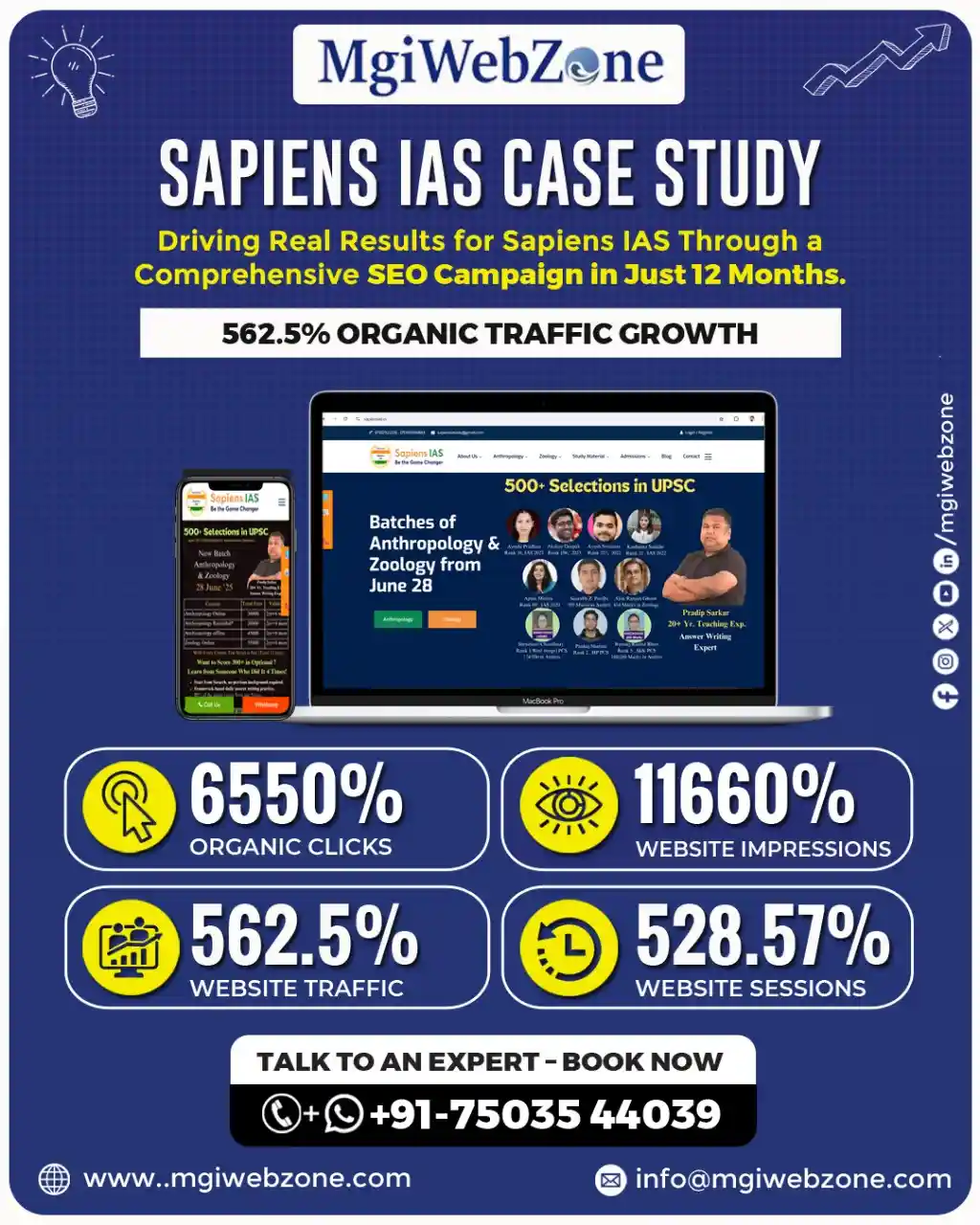
Sapiens IAS — Anthropology and Zoology optional coaching — demonstrated what subject-specific SEO and content marketing achieves in this segment: 3.28 million impressions, 137,000 clicks, 646% enrolment growth.
CSE 2023 UPSC Results — Electrical Engineering Makes History and Sociology Produces First-Attempt AIR 2
Aditya Srivastava of IIT Kanpur secured AIR 1 with Electrical Engineering optional — scoring 308/500 in the optional papers. He had previously achieved AIR 236 and used Electrical Engineering as a scoring weapon to reach the top rank. This result nearly doubled the coaching demand for Electrical Engineering optional almost immediately.
In the same cycle, Animesh Pradhan secured AIR 2 with Sociology in his very first attempt. Three words — first attempt, AIR 2 — rewired how every new aspirant thought about Sociology as an optional choice. The institutes that had already invested in Sociology optional coaching SEO and content marketing captured that demand wave.
And Donuru Ananya Reddy achieved AIR 3 in CSE 2023 with Anthropology optional — her first attempt. First attempt top-3 confirmed for both Sociology and Anthropology in the same cycle.
CSE 2024 UPSC Results — Four Consecutive Sociology Positions and a Historic PSIR Double
AIR 4, 5, 6, 7 — all Sociology. Shah Margi Chirag (AIR 4), Aakash Garg (AIR 5, second attempt), Komal Punia (AIR 6), Aayushi Bansal (AIR 7, third attempt). Four consecutive positions for one optional — never before in UPSC. And in the same cycle: Shakti Dubey (AIR 1, PSIR, 5th attempt) and Harshita Goyal (AIR 2, PSIR, 3rd attempt) — the first time in UPSC history that both AIR 1 and AIR 2 chose the same optional subject.
Also: Raj Krishna Jha (AIR 8) chose Public Administration — the subject’s best result in the post-2021 period and an important marketing asset for Public Administration coaching institutes. Mayank Tripathi (AIR 10) chose Geography — Geography’s only post-2021 top-10 result.
CSE 2025 UPSC Results — Medical Science Makes History and Sociology’s Back-to-Back AIR 2
Anuj Agnihotri secured AIR 1 with Medical Science optional, scoring 1,105/2025 total — equalling Shruti Sharma’s 2021 score, the joint-highest total in available verified data. MBBS from AIIMS Jodhpur, third attempt, result declared 6 March 2026. First-ever Medical Science AIR 1 in the single-optional era. Source: Verified from official UPSC merit list.
The full CSE 2025 top-10 by optional subject: Anuj Agnihotri AIR 1 (Medical Science), Rajeshwari Suve M AIR 2 (Sociology), Akansh Dhull AIR 3 (Commerce & Accountancy), Raghav Jhunjhunwala AIR 4 (Economics), Ishan Bhatnagar AIR 5 (Sociology), Zinnia Aurora AIR 6 (PSIR), A R Rajah Mohaideen AIR 7 (Anthropology), Pakshal Secretry AIR 8 (Economics), Astha Jain AIR 9 (PSIR), Ujjwal Priyank AIR 10 (Sociology).
Rajeshwari Suve M took AIR 2 with Sociology — back-to-back AIR 2 for Sociology in 2023 and 2025, unprecedented for any subject in any two-year window. Akansh Dhull secured AIR 3 with Commerce & Accountancy — two top-3 results for this niche subject in three years.
Any coaching institute offering Medical Science optional that invests in SEO, content marketing, and Google Ads in 2026 is positioning itself ahead of a demand wave that has already started.
AIR 1 Master List — Every UPSC Topper and Their Optional Subject (CSE 2013–2025)
UPSC CSE AIR 1 — Optional Subject Reference (Single-Optional Era: CSE 2013–2025)
CSE Year | AIR 1 Name | Optional Subject | Attempt | Confidence |
2013 | Gaurav Agrawal | Economics | ~1st | Reported |
2014 | Ira Singhal | Geography | 4th | Verified |
2015 | Tina Dabi | Philosophy | 1st | Verified |
2016 | Nandini KR | Kannada Literature | 2nd | Verified |
2017 | Anudeep Durishetty | Anthropology | 4th | Verified |
2018 | Kanishak Kataria | Mathematics | 1st | Verified |
2019 | Pradeep Singh | Public Administration | 2nd | Verified |
2020 | Shubham Kumar | Anthropology | 1st | Verified |
2021 | Shruti Sharma | History | — | Verified |
2022 | Ishita Kishore | PSIR | 3rd | Verified |
2023 | Aditya Srivastava | Electrical Engineering | 2nd (prev. AIR 236) | Verified |
2024 | Shakti Dubey | PSIR | 5th | Verified |
2025 | Anuj Agnihotri | Medical Science | 3rd | Verified |
Source: UPSC merit lists (Verified) or widely cited secondary sources (Reported). Always add qualifier when using Reported data. This covers the single-optional era only.
Notable patterns: Anthropology has two AIR 1s (2017, 2020). PSIR has two AIR 1s in three years (2022, 2024). History has two AIR 1s (2019 under Public Administration was the last Public Admin AIR 1; History’s AIR 1 came in 2021 with Shruti Sharma). Electrical Engineering achieved its first AIR 1 in 2023 (Aditya Srivastava). Medical Science achieved its first AIR 1 in 2025. Mathematics has one AIR 1 in the single-optional era (Kanishak Kataria, 2018). Geography’s last AIR 1 was in 2014.
Is your UPSC coaching institute visible on AI search, voice search, and social media?
MgiWebzone builds complete, 360° digital marketing strategies for education institutes — covering SEO, Ads, Social, Content, and AI visibility.
UPSC Subject-by-Subject Coaching Market Snapshot — All 25 Optional Subjects Explained
Tier 1 — The Three Largest UPSC Optional Coaching Markets (Above 40,000 Students)
PSIR Optional Coaching Market — 2025 Data Snapshot
Very Large | ★★★★★ | Est. ~72,400–77,900 students
Within the single-optional era: grew from 907 (2014) to peak 1,863 (2020) — a 105% increase — before settling at 1,571 (2021), still +73% above the 2014 single-era baseline. Estimated approximately 2,000+ from CSE 2023 onward.
Market share grew from 5.6% to 17.6% of all Mains candidates. Ishita Kishore AIR 1 (CSE 2022), Shakti Dubey AIR 1 and Harshita Goyal AIR 2 (CSE 2024) — first time in UPSC history both first and second rank chose the same optional. PSIR has appeared in the top-10 in all 4 post-2021 cycles. Success rate: 8.2–8.9%.
Digital marketing angle: Largest optional coaching market in India. Highest digital competition. An institute without subject-specific SEO for PSIR coaching — dedicated course pages, comparison content, faculty authority blogs, topper association articles — is losing students to whoever ranks first every single day.
Sociology Optional Coaching Market — 2025 Data Snapshot
Large | ★★★★★ | Est. ~61,600–66,200 students
Within the single-optional era: declined from 1,819 (2014) to 1,087 (2021) — a 40% fall in absolute numbers — but this occurred as the total Mains pool shrank 45%. Market share held at 11–12% throughout 2014–2021. Post-2021: 11 top-10 appearances, back-to-back AIR 2 in 2023 and 2025, four consecutive positions in CSE 2024. Estimated growing to ~1,700+ by 2025. Success rate: 8.5–10.0%.
Digital marketing angle: Fastest-growing major optional coaching market in post-2021 terms. First-attempt narrative from Animesh Pradhan (AIR 2, 2023) makes a large segment of new aspirants specifically search for Sociology coaching. Content marketing and blog SEO around “Sociology optional for first attempt,” “Sociology vs PSIR comparison” are among the highest-traffic clusters in UPSC coaching right now.
Anthropology Optional Coaching Market — 2025 Data Snapshot
Large | ★★★★★ | Est. ~44,000–47,000 students
Within the single-optional era: grew from 619 (2014) to 1,211 (2020) — a 96% increase — the single most dramatic documented growth in any major optional subject. Anudeep Durishetty AIR 1 (CSE 2017, 4th attempt, all-time record score of 1,126/2025) is the strongest single coaching-market catalyst in UPSC history. CSE 2022: 5 of 10 top rankers chose Anthropology — all-time record. Nidhi Pal AIR 36 scored 325/500 — highest optional score of CSE 2022. Success rate: 7.8–9.1%.
Digital marketing angle: Sapiens IAS — Anthropology and Zoology optional coaching, Delhi — demonstrates what complete digital marketing achieves: 3.28 million impressions, 137,000 clicks, 646% enrolment growth. Winning in Anthropology coaching means winning on faculty credibility content, test series pages, and AI-search visibility.
Tier 2 — Large and Growing UPSC Optional Coaching Markets (15,000–45,000 Students)
Geography Optional Coaching Market — 2025 Data Snapshot
Large (declining) | ★★★☆☆ | Est. ~41,500–44,700 students
Within the single-optional era: fell from 3,515 (2014) to 1,079 (2021) — a 69% decline (not 75% as some analyses incorrectly state using the 2012 two-optional era baseline). Market share declined from 21.6% to 12.1%. Last AIR 1: Ira Singhal, CSE 2014 — Geography has not produced a national topper since. Mayank Tripathi AIR 10 (CSE 2024) is the only post-2021 top-10 result.
Digital marketing angle: Large market, structurally declining. Highly competitive in Mukherjee Nagar and Old Rajinder Nagar coaching hubs. Institutes holding market share have invested in comparison keyword content — “Geography vs Anthropology for engineers,” “Geography optional cut-off analysis.”
Mathematics Optional Coaching Market — 2025 Data Snapshot
Medium | ★★★★☆ | Est. ~27,000–30,000 students
Within the single-optional era: grew from 351 (2014) to 513 (2021) — a 46% increase — the only major optional with sustained single-era growth from the 2014 baseline (note: earlier analyses using 2012 as baseline gave an incorrect +78% figure). Peak: 580 in 2020. One AIR 1 in the single-optional era: Kanishak Kataria (CSE 2018) — 361/500, the all-time highest optional score in UPSC history. No confirmed post-2021 top-10 Mathematics ranker. Highest coaching fees of any optional: ₹25,000–₹80,000 per student.
Digital marketing angle: IIT and engineering graduate audience — analytical, research-driven. The coaching institute whose faculty name appears clearly in searches for “Mathematics optional coaching for IIT graduates” wins this market. Subject-specific SEO and PPC delivers premium-quality leads.
Electrical Engineering Optional Coaching Market — 2025 Data Snapshot
Small-Medium (surging) | ★★★☆☆ | Est. ~8,000–9,000 students (post-2023 surge)
Within the single-optional era: Electrical Engineering had ~192 Mains candidates in 2014, declining to ~117 by 2021 (-39%). Then Aditya Srivastava, IIT Kanpur, won AIR 1 in CSE 2023 with Electrical Engineering — scoring 308/500 in the optional papers. Previously he had achieved AIR 236 in an earlier attempt; his return at AIR 1 via Electrical Engineering is one of the most dramatic improvement stories in recent UPSC history. Estimated participation growing to ~250 by 2025. Coaching market estimated to have nearly doubled since 2023.
Digital marketing angle: Near-zero digital competition nationally. An IIT/NIT electrical engineering graduate searching for Electrical Engineering optional coaching currently finds very little of quality online. The institute that builds a proper SEO-optimised website and content strategy for Electrical Engineering optional coaching will dominate this market with minimal competition.
History Optional Coaching Market — 2025 Data Snapshot
Medium | ★★★☆☆ | Est. ~23,170–24,900 students
Within the single-optional era: declined from 1,560 (2014) to 574 (2021) — a 63% fall (not 73% as analyses using 2012 baseline suggest). The last three official data years show stabilisation: 2019: 751, 2020: 581, 2021: 574. Shruti Sharma AIR 1 (CSE 2021) reversed the declining narrative. Three consecutive top-10 appearances in post-2021 cycles (AIR 9 in CSE 2023, AIR 9 in CSE 2024, plus AIR 1 in the preceding CSE 2021) — the strongest History run in the single-optional era. Estimated growing to ~640 by 2025.
Digital marketing angle: Humanities graduates’ default consideration. Stabilising demand. Steady SEO and content investment — faculty blogs, topper strategies, subject analysis — yields consistent enquiries.
Medical Science Optional Coaching Market — 2025 Data Snapshot
Small-Medium (surging post-2025) | ★★★★☆ | Est. ~10,150–10,920 students (2026 est.)
Within the single-optional era: 356 (2014) declining to 196 (2021) — a 45% fall. But Anuj Agnihotri AIR 1 (CSE 2025), 1,105/2025 total, AIIMS Jodhpur, 3rd attempt — the first Medical Science AIR 1 in the single-optional era — is a confirmed inflection point. Success rate: 10.7–12.2% across 2019–2021. MBBS graduate audience — focused, high decision-intent, limited time for extended research cycles.
Digital marketing angle: When an MBBS aspirant searches “Medical Science optional coaching online,” very few institutes appear. First-mover advantage in digital marketing for Medical Science optional coaching is still available in March 2026. Six months from now, it may not be.
Philosophy Optional Coaching Market — 2025 Data Snapshot
Small-Medium | ★★★☆☆ | Est. ~12,300–13,200 students
Within the single-optional era: declined from 908 (2014) to 265 (2021) — a 71% fall (note: some analyses cite decline from 1,116 in 2012, giving a false 76% figure using pre-reform data). Two top-3 results across different decades: Tina Dabi AIR 1 (CSE 2015, age 22, first attempt) and Dongre Archit Parag AIR 3 (CSE 2024, VIT Electrical Engineering) — the only optional where both an Arts student and an Engineering graduate reached the very top in different decades.
Digital marketing angle: The GS Paper 4 (Ethics) synergy is the most underused content marketing angle in Philosophy coaching. The institutes that build content around “how Philosophy optional helps with Ethics paper” and “Philosophy optional for engineers” are capturing the specific queries that conversion-ready aspirants actually search.
Economics Optional Coaching Market — 2025 Data Snapshot
Small | ★★★☆☆ | Est. ~10,600–11,400 students
Within the single-optional era: broadly stable. Started at 214 Mains candidates (2014), fluctuated, ended at 190 (2021) — an 11% decline. Gaurav Agrawal AIR 1 (CSE 2013, Reported) — IIT BTech + IIM Ahmedabad MBA + Delhi School of Economics — established the aspiration template for this subject.
In CSE 2025, two of the top ten chose Economics (Raghav Jhunjhunwala AIR 4 from SRCC, Pakshal Secretry AIR 8 from IIT Kanpur). Predictable demand from Economics graduates and analytical-background aspirants.
Commerce & Accountancy Optional Coaching Market — 2025 Data Snapshot
Small | ★★★☆☆ | Est. ~9,100–9,800 students
Within the single-optional era: started at 214 candidates (2014), broadly stable through to 140 (2021) — 35% decline but with recovery signals (210 in 2020). 15.0% success rate (2021, joint highest).
Garima Lohia AIR 2 (CSE 2022) and Akansh Dhull AIR 3 (CSE 2025) — two top-3 results in three years. CA graduates, B.Com, MBA Finance — tight professional network, high referral velocity. Estimated growing to ~240 Mains candidates by 2025.
Digital marketing angle: When a result like Akansh Dhull AIR 3 spreads through CA community WhatsApp groups, coaching enquiries follow within days. Combine this organic word-of-mouth with Google Ads targeting CA aspirants and social media marketing on LinkedIn and Instagram to convert that interest into paid admissions efficiently.
Public Administration Optional Coaching Market — 2025 Data Snapshot
Small (declining) | ★★☆☆☆ | Est. ~9,600–10,300 students (2026 est.)
Within the single-optional era: declined from 2,852 (2014) to 361 (2021) — an 87% fall. This is the most dramatic structural decline of any optional subject in the single-optional era. Note: some analyses cite “97% from 2012” — this incorrectly uses the pre-reform two-optional era count as the starting point.
The correct single-optional era baseline is 2,852 (2014). The genuine single-era decline is -87% — still the most severe, but the correct figure. Pradeep Singh AIR 1 (CSE 2019) was the last Public Administration national topper, and Raj Krishna Jha AIR 8 (CSE 2024) is the subject’s best recent result and its primary current marketing asset.
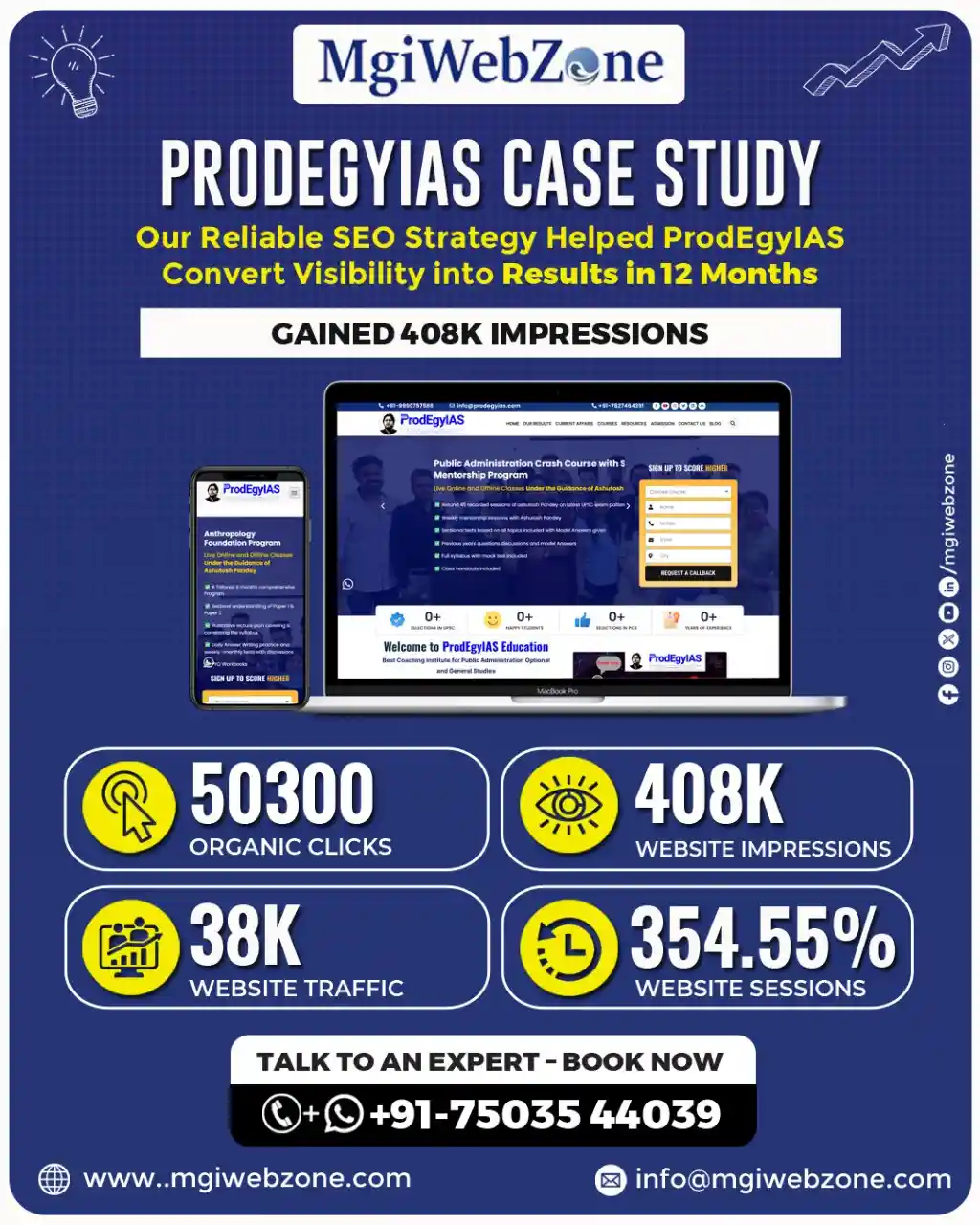
Digital marketing angle: ProdEgyIAS operates in this segment and invested in lead generation PPC campaigns, SEO, and content marketing for Public Administration coaching. Even in a declining segment, targeted digital marketing produces real enquiries. The students who still choose this subject are making a deliberate choice — and they search online just as actively as anyone else.
Law Optional Coaching Market — 2025 Data Snapshot
Small | ★★☆☆☆ | Est. ~10,025–10,790 students
Within the single-optional era: declined from 235 (2014) to 180 (2021) — a 23% fall, relatively contained. Jeydev CS AIR 5 (CSE 2019) remains the subject’s strongest recent signal. LLB and LLM audience — committed, specific, and making careful decisions.
Digital marketing angle: A targeted SEO and content strategy for Law optional coaching can establish national online leadership in this segment within 6–12 months. No major coaching institute has dominated this keyword category online yet.
Tier 3 — Niche and Specialist UPSC Optional Coaching Markets
(All figures are single-optional era data. 2012 pre-reform figures excluded from all comparisons.)
Physics Optional — Est. ~4,640–4,990 students | ★★☆☆☆ | Single-era decline from ~198 (2014) to 131 (2021) — approximately -34%. IIT Physics and BSc/MSc Physics graduates. Very limited digital competition for Physics optional coaching online.
Chemistry Optional — Est. ~4,480–4,820 students | ★★☆☆☆ | Single-era decline from 192 (2014) to 127 (2021) — -34%. IIT/MSc Chemistry graduates. Chemistry confirmed in PIB top-25 for CSE 2025. Stable niche with no significant SEO competition for Chemistry optional coaching online.
Zoology Optional — Est. ~3,120–3,360 students | ★★☆☆☆ | Stable at 56–89 Mains candidates throughout single-era. BSc/MSc Zoology graduates. Sapiens IAS serves both Anthropology and Zoology — their 3.28M impressions result covers both subjects. Smriti Mishra AIR 4 (CSE 2022) is the subject’s highest-ever ranking in the single-optional era.
Agriculture Optional — Est. ~6,400–6,890 students | ★★☆☆☆ | Single-era decline from 202 (2014) to 115 (2021) — -43%. Agriculture university graduates. Location-based SEO for agriculture optional coaching works particularly well — students often search by state or university.
Civil Engineering Optional — Est. ~5,570–5,990 students | ★★☆☆☆ | Single-era decline from ~183 (2014) to ~100 (2021) — approximately -45%. IIT Civil graduates. Benefits from the “engineering optionals work” confidence since Aditya Srivastava’s Electrical Engineering AIR 1 in CSE 2023. No notable digital marketing presence from any coaching institute in this segment.
Mechanical Engineering Optional — Est. ~4,460–4,800 students | ★★☆☆☆ | Single-era decline from ~138 (2014) to ~80 (2021) — approximately -42%. IIT Mechanical graduates. Zero competition online.
Psychology Optional — Est. ~4,060–4,370 students | ★☆☆☆☆ | Single-era decline from 373 (2014) to 127 (2021) — -66% (note: the commonly cited “86% decline” compares the 2012 two-optional era count of 1,163 with post-2013 data — this is incorrect). GS Paper 4 (Ethics) preparation synergy remains the strongest marketing argument.
Management Optional — Est. ~940–1,015 students | ★☆☆☆☆ | 16.1% success rate (2021) — highest of any subject in the dataset. Stable at 31–54 Mains candidates in the single-era (2014 baseline: 54 candidates). IIM, MBA, PGDM graduates. Almost completely unknown in coaching marketing. Content marketing for Management optional coaching would face near-zero national competition.
Botany Optional — Est. ~1,780–1,920 students | ★★☆☆☆ | Stable at 31–47 candidates in the single-era. BSc/MSc Botany graduates.
Geology Optional — Est. ~1,615–1,740 students | ★☆☆☆☆ | Stable at 27–42 candidates. IIT, ISM Dhanbad, state university geology graduates.
Animal Husbandry Optional — Est. ~1,000–1,080 students | ★☆☆☆☆ | Stable at 17–28 candidates in the single-era. Veterinary science graduates. One-to-one mentoring only.
Statistics Optional — Est. ~167–180 students at Prelims stage | ★☆☆☆☆ | 3–6 Mains candidates per year in the single-era. ISI and CMI graduates only. Below minimum viable batch size. No conventional coaching marketing is viable.
What UPSC Post-2021 Trend Data Tells Us — CSE 2022 to 2025 Directional Analysis
Why UPSC Official Optional Subject Data Stops at CSE 2021
The UPSC 73rd Annual Report (2022–23) is the most recently published report as of March 2026. No official subject-wise Mains participation data for CSE 2022, 2023, 2024, or 2025 has been released. All post-2021 figures are estimates.
UPSC Optional Subjects Likely Growing — CSE 2022–2025 Directional Estimates
1) PSIR — estimated approximately 1,800–2,000+ Mains candidates. Confirmed top-10 in all four post-2021 cycles. Both AIR 1 and AIR 2 in CSE 2024 were PSIR. SEO competition for PSIR optional coaching is rising — acting early still gives more efficient returns.
2) Anthropology — estimated approximately 1,200–1,400. Five of ten top-10 in CSE 2022 is the strongest single-year result by any subject. Market remains large and well-supported.
3) Sociology — estimated ~1,200 to ~1,700+. After holding stable market share throughout 2014–2021, 11 top-10 results across 2022–2025 confirm genuine absolute growth is now occurring.
4) Electrical Engineering — estimated ~130 to ~250. Aditya Srivastava AIR 1 (CSE 2023) nearly doubled the coaching market. Growth continues. Coaching institutes investing in digital marketing for Electrical Engineering optional in 2026 are building ahead of rising competition.
5) Medical Science — Anuj Agnihotri AIR 1 (CSE 2025) is a confirmed inflection point. MBBS community awareness building rapidly. The coaching institute that invests in SEO, Google Ads, and content marketing for Medical Science optional in 2026 is building ahead of demand.
UPSC Optional Subjects Likely Continuing to Decline (2022–2025)
Public Administration, Psychology, and Geography all show weakening single-era trends with limited post-2021 topper signals. Public Administration did produce AIR 8 in CSE 2024 (Raj Krishna Jha) — its only post-2021 top-10 result and a valuable marketing asset.
And here is what most coaching institutes miss: the coaching institutes in declining segments investing in digital marketing and search visibility right now are capturing a smaller pool with far less competition. Declining segments need digital marketing more urgently, not less.
What This UPSC Optional Subject Data Means If You Run a Coaching Institute
The Problem Most UPSC Coaching Institutes Don’t See in This Data
The market is real. Whether your subject has an estimated 70,000 coaching students or 7,000 — serious aspirants are searching for optional coaching right now. Tonight. From a hostel room in Prayagraj. From a shared flat in Old Rajinder Nagar. From a phone in a tier-2 city.
When they search, which institute appears?
Your institute might have better faculty than anyone in your city. Your batches may have produced toppers. None of that matters in the moment when a student types “Anthropology optional coaching best institute” into Google at 11pm — if your website is not on page one.
And here is what most coaching institutes that have tried digital marketing for UPSC coaching before have experienced: they hired a general agency, got generic results, paid months of fees, and walked away with nothing. The issue is never digital marketing itself. The issue is that a general agency does not know what PSIR optional means. They do not know the difference between a Prelims enquiry and a Mains coaching enquiry. They cannot write content that makes an Anthropology aspirant feel: “this institute understands my preparation.”
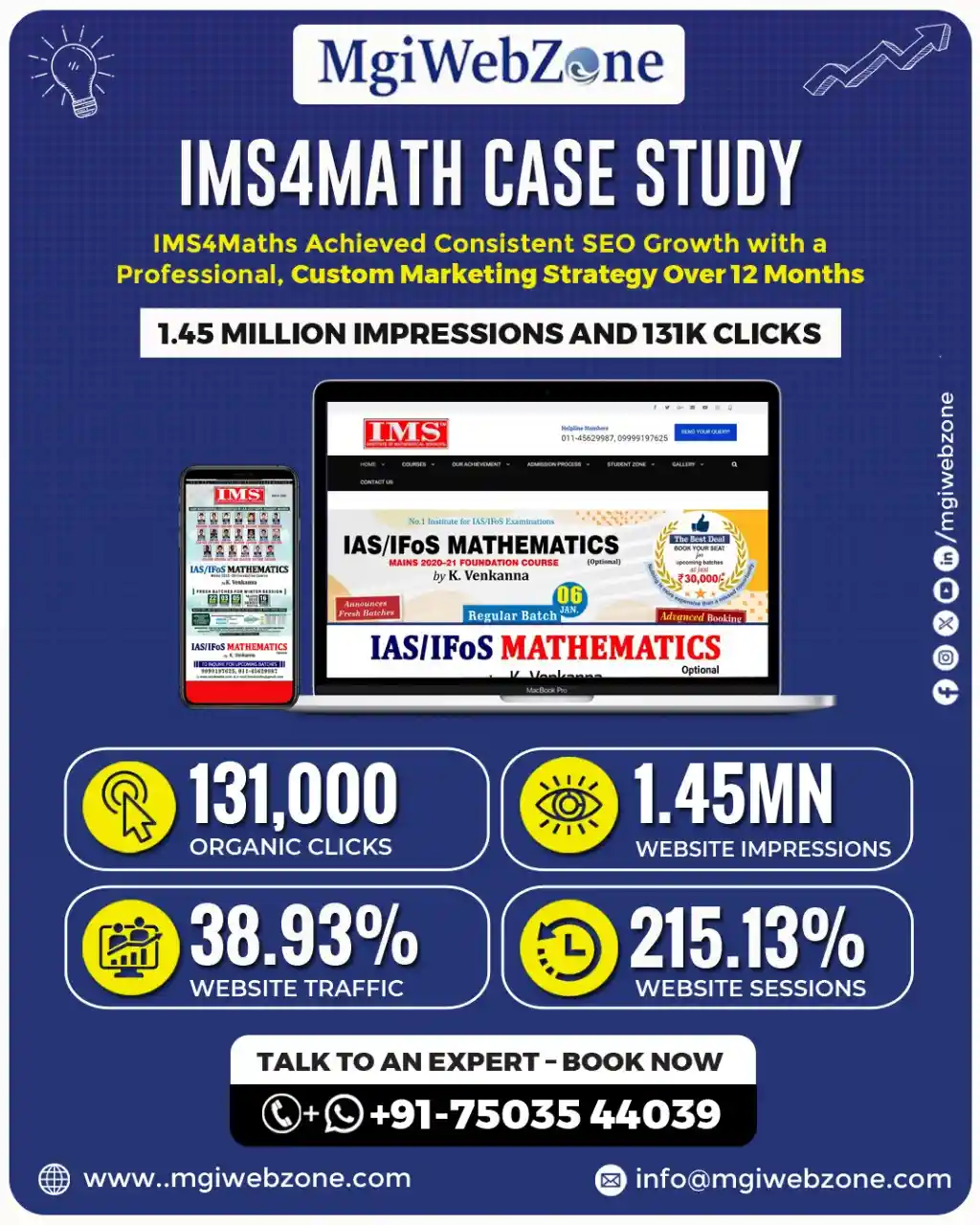
MgiWebzone does. We have been working specifically in digital marketing for UPSC Civil Services coaching institutes for over 12 years and with more than 1,000 clients. We helped IMS4Maths — a Mathematics optional coaching institute that most agencies would call too niche — reach 1.45 million impressions and 131,000 clicks. K. Venkanna Sir said it directly: “The quality of leads improved drastically. These weren’t just casual visitors — they were serious students.”
See the IMS4Maths case study →
What Actually Works for UPSC Optional Subject Coaching Institutes Online
Subject-specific content clusters drive enquiries. Generic “UPSC coaching” pages do not. A student searching “Electrical Engineering optional coaching” has already made their subject decision — they are comparing institutes.
Every optional coaching institute needs dedicated course pages, subject-expert blogs, topper analysis articles, and comparison content built around their specific optional. This is the content marketing strategy for UPSC optional coaching that produces admissions-ready leads.
Faculty authority pages and topper association content convert 3–4 times better than general blog traffic. When a student can read about your faculty’s own UPSC background and see optional scores from your students — the gap between browsing and calling for a demo class closes fast. This is E-E-A-T in practice and the most sustainable SEO strategy for coaching institutes.
AI search visibility is not the future — it is right now. Students are already asking ChatGPT, Gemini, and Google AI Overviews: “which is the best Sociology optional coaching institute in Delhi?” If your institute does not appear in those AI-generated answers, you are losing a growing share of enquiries.
AEO (Answer Engine Optimisation) and GEO (Generative Engine Optimisation) for coaching institutes is built into every MgiWebzone engagement.
Most institutes spending on Google Ads are failing at the landing page, not the ad. The ad brings the student. If the landing page is slow, unclear about fees and batch dates, or not mobile-optimised — that student leaves without enquiring. Professional website design for coaching institutes starting from ₹25,000 is the infrastructure that decides whether your Google Ads budget produces enquiries or just impressions. Website design packages →
Who Should Read This UPSC Optional Subject Data Most Carefully
Large optional institutes with strong classroom reputations who have not invested significantly in digital marketing for UPSC coaching. Reputation travels by word of mouth. It does not travel by Google search.
Mid-size institutes that tried a general digital marketing agency and got generic results. The problem was not digital marketing — it was the agency not understanding PSIR optional coaching as distinct from any other education product. MgiWebzone’s SEO packages for UPSC coaching institutes start at ₹35,000/month — built specifically for optional coaching. See SEO packages →
New institutes deciding which optional subject to specialise in. This report gives you the actual single-optional era market data, growth signals, success rates, digital competition signals, and topper momentum for all 25 subjects — based on data, not guesswork.
UPSC Optional Subject Coaching Market Methodology — How Estimates Were Calculated
Official UPSC Data Sources Used in This Report
UPSC Annual Reports (58th through 73rd) — single-optional era Mains participation for CSE 2014, 2015, 2016, 2017, 2019, 2020, 2021. Full exam funnel from applied through finally selected. PIB press releases — overall funnel data for CSE 2022 to 2025. UPSC merit lists and PIB result announcements — top-10 optional subject data for CSE 2022 to 2025 (all Verified).
How UPSC Optional Coaching Market Estimates Were Derived
Coaching market formula: (Subject Mains Candidates ÷ Total Mains Candidates) × (Total Prelims Appeared × 95%)
Applied using CSE 2021 as the official single-optional era data base, combined with CSE 2025 Prelims appeared for current market estimates. Post-2021 directional projections use topper performance signals and trend continuation. The 2012 pre-reform figure is never used in any market calculation.
What This UPSC Optional Subject Report Does Not Claim
Post-2021 subject-level participation numbers are estimates — not official UPSC data. Two-optional era (2012) figures are included for historical reference only and must not be used in trend or growth analysis. Market value figures are estimates based on fee ranges, not audited revenue data. Success rates are from CSE 2019–2021 Annual Report data.
Frequently Asked Questions — UPSC Optional Subjects, Coaching Market, and Selection Data
Which UPSC optional subject has the largest coaching market in 2026?
PSIR has the largest estimated coaching market — approximately 72,400–77,900 students at the Prelims preparation stage. Within the single-optional era, PSIR grew from 907 Mains candidates (CSE 2014) to 1,571 (CSE 2021) — a 73% increase — while simultaneously growing its market share from 5.6% to 17.6% of all Mains candidates. Source: UPSC Annual Reports + MgiWebzone estimate.
Which UPSC optional subject produced the most top-10 rankers from 2022 to 2025?
Sociology produced 11 top-10 appearances across CSE 2022, 2023, 2024, and 2025 — the highest of any optional. Anthropology had 9, PSIR had 7. Together they accounted for 27 of 40 top-10 positions. Source: Verified from UPSC merit lists and PIB press releases.
What is the estimated coaching market size for PSIR optional in 2026?
Approximately 72,400–77,900 students at the Prelims stage — derived from PSIR’s estimated 2,000 Mains candidates using the formula: Mains candidates × 56.9 (Prelims-to-Mains ratio) × 65% coaching rate. PSIR grew 105% within the single-optional era from its 2014 baseline of 907 candidates to its 2020 peak of 1,863. Source: UPSC 73rd Annual Report + MgiWebzone estimate.
What is the estimated coaching market size for Sociology optional in 2026?
Approximately 61,600–66,200 students. Important note: within the single-optional era (2014–2021), Sociology declined from 1,819 to 1,087 Mains candidates — a 40% absolute fall. However, this occurred as the total Mains pool shrank 45%, so Sociology’s market share actually held stable. Post-2021, Sociology is growing strongly — 11 top-10 appearances across 2022–2025 and estimated 1,700+ Mains candidates by 2025.
What is the estimated coaching market size for Anthropology optional in 2026?
Approximately 44,000–47,000 students. Anthropology grew from 619 Mains candidates (CSE 2014 single-era baseline) to 1,211 (CSE 2020 peak) — a 96% increase. By CSE 2021, 1,159 candidates (+87% from 2014). CSE 2022 confirmed 5 of 10 top rankers choosing Anthropology — all-time record for any subject. Source: UPSC Annual Reports + MgiWebzone estimate.
Which UPSC optional subject has the highest success rate?
Based on CSE 2021 data, Management optional had 16.1% — highest of any subject in the dataset. Commerce & Accountancy had 15.0%. Medical Science had 10.7–12.2% across 2019–2021. Note: Management and Commerce & Accountancy have very small candidate pools. Commerce & Accountancy’s combination of high success rate and two recent top-3 results makes it the most compelling niche coaching opportunity. Source: UPSC Annual Reports.
How is the UPSC optional subject coaching market size calculated?
Formula: (Subject’s Mains Candidates ÷ Total Mains Candidates) × (Total Prelims Appeared × 95%). Results are 40–55 times larger than Mains count because students join optional coaching 12–18 months before Mains. Only single-optional era (2014–2021) Mains data is used as the baseline — never 2012 two-optional era figures. All figures using this formula are estimates, not official UPSC data.
Is Public Administration optional still a viable choice for UPSC in 2026?
Within the single-optional era, Public Administration declined from 2,852 Mains candidates (CSE 2014) to 361 (CSE 2021) — an 87% fall. Note: the commonly cited “97% collapse from 2012” is incorrect — it uses the pre-reform two-optional era count as the baseline. The estimated 2026 coaching market is approximately 9,600–10,300 students. Raj Krishna Jha AIR 8 (CSE 2024) is the subject’s best recent result. For coaching institutes offering Public Administration optional, targeted digital marketing can still produce real enquiries in this low-competition space.
Why should 2012 UPSC optional subject data NOT be compared with post-2014 data?
Before CSE 2013, every Mains candidate chose TWO optional subjects. From CSE 2013 onward, only ONE is allowed. In 2012, the same student could choose Geography as first optional and Public Administration as second — contributing to both counts. The 2012 total optional subject appearances across all subjects was approximately twice the total Mains candidates (~24,380 appearances for ~12,190 candidates).
Direct comparison of 2012 figures with post-2013 data misrepresents both growth and decline for every subject. All trend analysis in this report uses 2014 (the first fully comparable single-optional year) as the baseline. Source: UPSC examination pattern change, effective 2013.
What optional subject did the UPSC CSE 2023 AIR 1 choose?
Aditya Srivastava of IIT Kanpur chose Electrical Engineering optional and secured AIR 1 in CSE 2023, scoring 308/500 in the optional papers. He had previously achieved AIR 236 in an earlier attempt. His AIR 1 is one of the most dramatic improvement stories in UPSC — and directly triggered a surge in Electrical Engineering optional coaching demand. Source: Verified from official UPSC merit list.
What optional subject did the UPSC CSE 2024 AIR 1 choose?
Shakti Dubey chose PSIR (Political Science & International Relations) for AIR 1 in CSE 2024, her fifth attempt. In the same cycle, Harshita Goyal chose PSIR for AIR 2 — the first time in UPSC history that both AIR 1 and AIR 2 chose the same optional. Source: Verified from official UPSC merit list.
What optional subject did the UPSC CSE 2025 AIR 1 choose?
Anuj Agnihotri chose Medical Science optional, scoring 1,105/2025 total — equalling Shruti Sharma’s 2021 score, the joint-highest in available verified data. He is an MBBS graduate from AIIMS Jodhpur who cleared in his third attempt. Result declared 6 March 2026. This is the first Medical Science AIR 1 in the single-optional era (post-2013). Source: Verified from official UPSC merit list.
Has any engineering graduate topped UPSC recently, and with which optional?
Yes. Aditya Srivastava (IIT Kanpur) topped CSE 2023 with Electrical Engineering optional — scoring 308/500. Kanishak Kataria (IIT Bombay, Computer Science) topped CSE 2018 with Mathematics optional — 361/500, the all-time highest optional score in UPSC history. Dongre Archit Parag (VIT, Electrical Engineering) achieved AIR 3 in CSE 2024 with Philosophy optional. Engineering graduates appear in top-10 results across PSIR, Mathematics, Electrical Engineering, and Philosophy.
What is the total size of the UPSC optional coaching market in India in 2025?
Approximately 5,76,793 Prelims appeared in CSE 2025. At 65% coaching participation, the estimated active UPSC coaching market is approximately 3.75 lakh students per exam cycle. The combined estimated market across the top 5 optionals alone (PSIR, Sociology, Anthropology, Geography, Mathematics) exceeds approximately 2.5 lakh students at the Prelims stage. Source: UPSC Annual Reports + PIB.
Which UPSC optional subject is most suitable for first-attempt aspirants?
No subject is universally best — it depends on educational background. Sociology is widely regarded as accessible for first-attempt aspirants without a specific domain background. Animesh Pradhan’s AIR 2 in his very first attempt (CSE 2023, Sociology) remains the most cited example. Mathematics is strongly recommended only for IIT or engineering backgrounds. For coaching institutes, content marketing around “optional subject selection for first attempt” is consistently one of the highest-traffic keyword clusters in UPSC preparation.
Why is official UPSC optional subject data only available up to CSE 2021?
UPSC Annual Reports are published 18–24 months after the exam year. The 73rd Annual Report (2022–23) covers data through CSE 2021. No subject-wise Mains participation data for CSE 2022, 2023, 2024, or 2025 has been officially published as of March 2026. Post-2021 estimates in this report are clearly labelled directional projections. Source: UPSC Annual Reports.
What is the Prelims-to-Mains ratio used to calculate UPSC optional coaching market size?
The ratio used is 56.9 — derived from CSE 2021: 5,08,619 Prelims appeared ÷ 8,930 Mains appeared = 56.9. This means approximately 56.9 students appear for Prelims for every 1 student who sits Mains. All coaching market figures using this ratio are estimates — using single-optional era data only. Source: UPSC 73rd Annual Report.
Which UPSC optional subject has the smallest coaching market?
Statistics optional — 3 Mains candidates in CSE 2021. Estimated Prelims-stage pipeline approximately 167–180 students nationally — below minimum viable batch size. One-to-one mentoring for ISI and CMI Statistics graduates is the only viable model. Source: UPSC Annual Reports.
How many students appear for UPSC Prelims each year in India?
From 4,46,623 in CSE 2014 to approximately 5,76,793 in CSE 2025. The CSE 2025 appearance rate of 61.5% is the highest ever recorded — meaning 61.5% of applicants actually sat the exam. Source: UPSC Annual Reports + PIB.
Is Sociology optional still growing after CSE 2024 and CSE 2025 results?
Post-2021 signals confirm strong growth. 11 top-10 appearances across 2022–2025. Back-to-back AIR 2 results (2023 and 2025). Four consecutive top-10 positions in CSE 2024. Estimated Mains candidates growing from ~1,087 (2021) to ~1,700+ (2025). Important context: within the official single-optional era (2014–2021), Sociology’s absolute Mains count declined -40% — but that was against a Mains pool that itself shrank 45%, so market share held stable. The current growth is genuine and strong. All post-2021 figures are estimates.
Which UPSC optional subject commands the highest coaching fees?
Mathematics optional typically commands ₹25,000–₹80,000 per student — the highest of any optional — because the IIT and engineering graduate audience has both the financial capacity and the specific demand for specialised faculty. Medical Science optional runs ₹25,000–₹70,000. Electrical Engineering is growing toward ₹25,000–₹60,000 following Aditya Srivastava’s AIR 1 result. PSIR and Sociology have more varied fee structures (₹20,000–₹70,000) due to broader competition.
What does effective digital marketing for UPSC optional coaching institutes actually include?
A complete digital marketing strategy for UPSC optional coaching includes: subject-specific SEO with dedicated course pages and content clusters, faculty authority content and topper association pages, Google Ads campaigns targeting buying-intent keywords like “PSIR optional coaching Delhi,” social media marketing for brand trust and demo class enquiries, AI search visibility (AEO/GEO) so your institute appears in Google AI Overviews and ChatGPT responses, and a conversion-optimised website. MgiWebzone provides all of these — SEO packages starting at ₹35,000/month, PPC management from ₹25,000/month, website design from ₹25,000. See all packages →
Does SEO actually work for UPSC optional subject coaching institutes, or is word-of-mouth enough?
Word-of-mouth fills your known circle. SEO fills your batches with students who have never heard of you but are actively searching right now. In CSE 2025, over 5.76 lakh students appeared for Prelims. Most of them searched for optional coaching online before they made a decision. If your institute is not on page one, that search ends at your competitor’s website. See what our SEO packages for UPSC coaching deliver →
How long does it take to see results from SEO for a UPSC coaching institute?
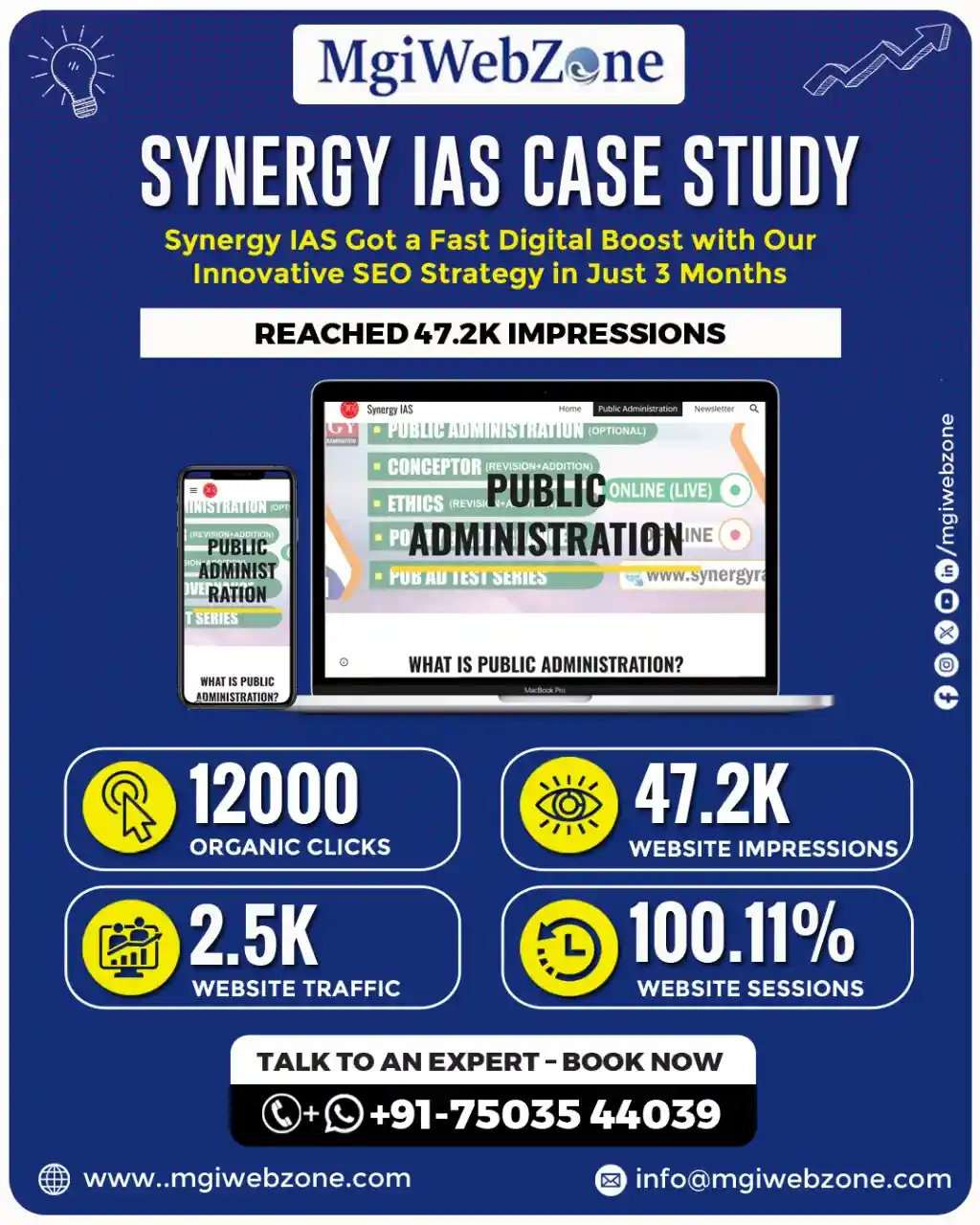
Most coaching institutes see meaningful movement — improved keyword rankings, more organic website visitors, increased enquiries — within 3 to 6 months of consistent SEO. Synergy IAS generated 12,000 organic clicks in just 3 months. Results depend on your starting point, the subject you teach, and how competitive your target keywords are. One initial consultation gives you a realistic, month-by-month picture. See SEO packages →
What does MgiWebzone’s SEO service for UPSC coaching institutes actually include?
Our SEO for UPSC coaching covers on-page optimisation, technical fixes, subject-specific content clusters, local SEO, off-page authority building, Google Search Console monitoring, and monthly keyword ranking reports. We also build AEO and GEO signals so your institute appears in Google AI Overviews, ChatGPT, and Gemini responses — not just on page one. Everything is explained in plain language, with no jargon-heavy reports that leave you more confused than before. Full SEO package details →
What results has MgiWebzone delivered for UPSC coaching institutes?
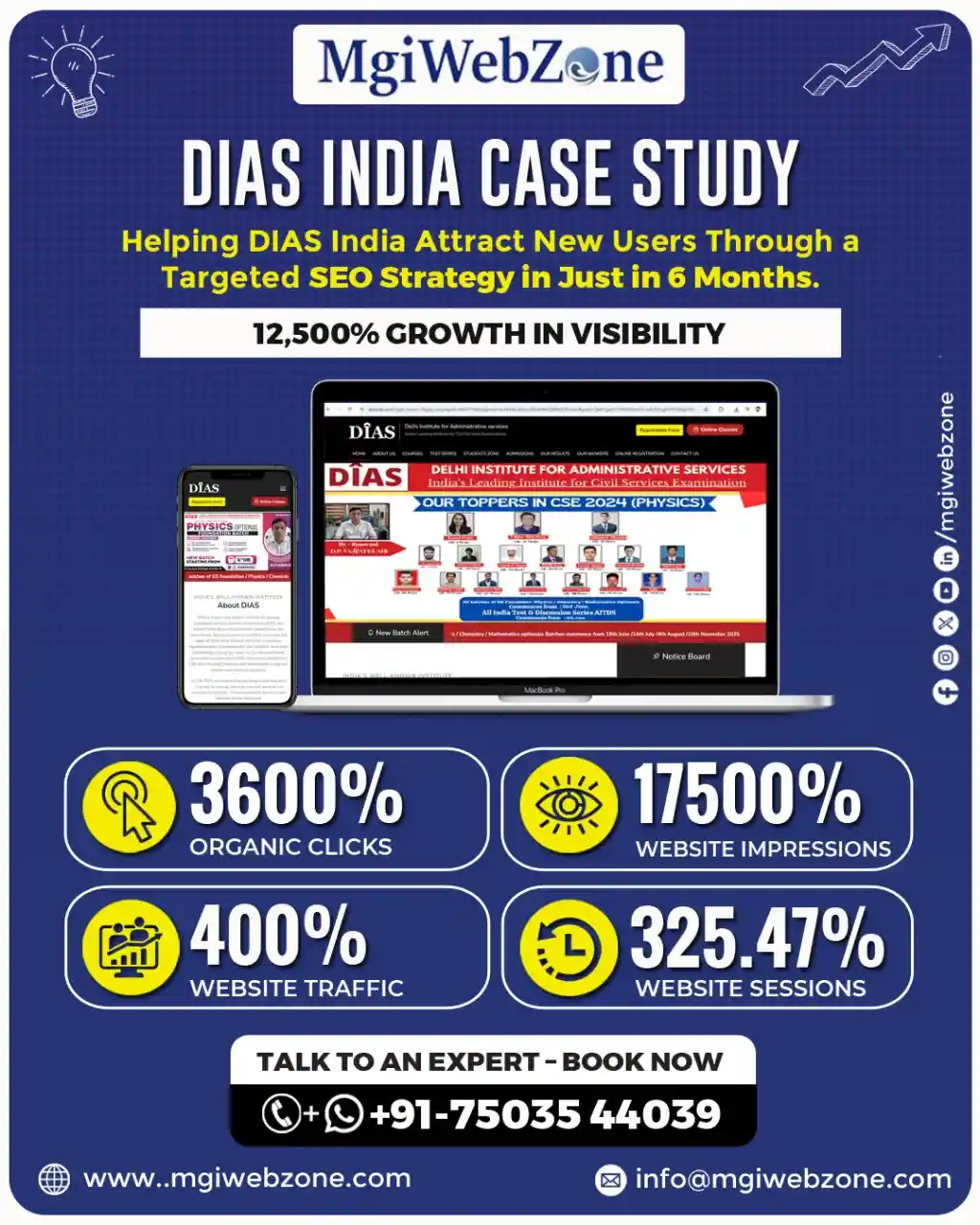
Here are confirmed numbers from actual clients. Sapiens IAS (Anthropology & Zoology optional): 3.28 million impressions, 137,000 clicks, 646% enrolment growth. IMS4Maths (Mathematics optional): 1.45 million impressions, 131,000 clicks. ProdEgyIAS (Public Administration optional): 408,000 impressions, 50,300 clicks. DIAS India: 12,500% visibility growth, 3,600% click growth. Synergy IAS: 12,000 organic clicks in 3 months. These are niche coaching institutes — not large national brands with unlimited budgets. Read the full case studies →
Why should a UPSC coaching institute run Google Ads? Our batches are already partially full.
Partially full is not full. And here is the thing — the students filling the remaining seats are the ones searching online right now. Google Ads for UPSC coaching targets students who are already in the decision stage: searching for “Anthropology optional coaching Delhi” or “PSIR coaching near me.” You only pay when they click. If your batches are 60% full from word-of-mouth, the remaining 40% is sitting in a Google search box. See PPC packages →
How does MgiWebzone run Google Ads campaigns for UPSC coaching institutes differently from a general agency?
A general agency will target keywords like “UPSC coaching Delhi” and call it done. We target buying-intent keywords tied to your specific optional subject, your city, and your batch cycle — “PSIR optional coaching Old Rajinder Nagar,” “Sociology optional test series Delhi,” “Anthropology optional demo class.” We also build and optimise your landing page because, in our experience, most institutes that fail at Google Ads are not failing at the ad — they are failing at the page the student lands on. PPC packages →
How much do MgiWebzone’s digital marketing services cost for a UPSC coaching institute?
SEO packages start at ₹35,000 per month. PPC campaign management starts at ₹25,000 per month (ad spend is separate). Website design packages start at ₹25,000 (one-time). Social media management packages start at ₹25,000 per month. Every package is built around your optional subject, your city, and your batch size — not a copy-paste template. One conversation is all it takes to know exactly what investment makes sense for your situation. Call or WhatsApp: +91-7503544039
Does my UPSC coaching institute actually need a new website, or will SEO fix the existing one?
Depends on what is currently there. If your site loads slowly, is not mobile-optimised, or does not have clear course pages for each optional subject and batch — SEO cannot fully compensate. A student who lands on a slow, confusing website leaves without enquiring regardless of how well you rank. We assess existing websites honestly before recommending a redesign. If the structure is salvageable, we fix it. If it is holding you back, we tell you plainly. Website design packages →
What does MgiWebzone’s website design package include for UPSC coaching institutes?
Our coaching institute website packages include mobile-first responsive design, WordPress CMS (so you can update batch dates and fee information without a developer), subject-specific course pages, faculty profile pages, SEO-friendly URL structure, Google Analytics setup, Google Search Console integration, WhatsApp button, call button, blog setup, and free domain, hosting, and SSL certificate. Starting from ₹25,000, one-time. Built to convert visitors into demo class bookings. Website design packages →
Will social media marketing actually bring enquiries for a UPSC optional coaching institute?
It depends on how it is done. Random posts do not bring enquiries. A structured social media strategy — faculty authority content, topper stories from your batches, optional subject analysis posts, batch announcement creatives — builds the trust that converts a visiting student into a demo class booking. Students check an institute’s Instagram and Facebook before they call. What they find there decides whether they call at all. Social media packages →
What is AEO and GEO, and why does it matter for UPSC coaching marketing in 2026?
AEO is Answer Engine Optimisation — structuring your content so that ChatGPT, Gemini, and Perplexity cite your institute when a student asks “best PSIR optional coaching in Delhi.” GEO is Generative Engine Optimisation — the signals that make AI tools trust your institute as an authoritative source. Students are increasingly using AI tools before they ever open Google. If your institute does not appear in those AI-generated answers, you are invisible to a growing segment of aspirants. MgiWebzone builds both into every engagement. See SEO packages →
Can MgiWebzone help a new UPSC coaching institute with no existing online presence?
Yes. And starting from scratch has one clear advantage — there is nothing broken to fix. We build the website, the subject-specific content clusters, the Google Business Profile, and the initial SEO foundation together. For a new institute, the first 6 months are about establishing authority in your optional subject niche online. Institutes that invest in this early capture the market before competition builds. One conversation tells you exactly what your starting roadmap looks like. Call or WhatsApp: +91-7503544039
My UPSC coaching institute teaches a niche optional subject like Electrical Engineering or Medical Science. Is digital marketing viable for such a small market?
This is where digital marketing is most powerful — and most underused. IMS4Maths serves Mathematics optional coaching. Most agencies said the market was too small. We delivered 1.45 million impressions and 131,000 clicks. A student searching “Electrical Engineering optional coaching India” has already made their subject decision — they just need to find you. A niche market with zero digital competition means your investment goes much further. See what we did for IMS4Maths →
How does MgiWebzone approach content marketing for UPSC optional coaching institutes?
We build subject-specific content clusters — not generic “UPSC preparation tips” blogs. Each cluster includes a core course page (your main conversion page), supporting articles around topper strategies for your subject, subject selection guides, faculty authority posts, and comparison content (“Sociology vs PSIR for first attempt”). This is the content that appears in Google searches and AI Overviews. It targets students who are already deep in their decision process. SEO and content packages →
We tried a digital marketing agency before and it did not work. Why would MgiWebzone be different?
The most common reason it did not work is that a general agency treated your Anthropology optional coaching the same way they would treat a furniture store. They did not know what PSIR means, what a Prelims enquiry looks like versus a Mains coaching enquiry, or how to write content that makes an aspirant feel understood. MgiWebzone has worked exclusively with UPSC coaching institutes for 12+ years. That difference shows in results, not in pitch decks. Read client case studies →
What is the difference between MgiWebzone’s SEO and PPC services for UPSC coaching?
SEO builds long-term, compounding visibility — a blog or course page that ranks today keeps bringing enquiries for months without additional spend. PPC brings immediate, targeted visibility — your ad appears at the top of Google the day your campaign goes live. For most coaching institutes, the right answer is both, sequenced correctly: PPC while SEO builds, then reducing PPC dependence as organic rankings strengthen. We build that plan based on your batch cycle and budget. SEO packages → | PPC packages →
How does MgiWebzone measure and report results for UPSC coaching digital marketing campaigns?
Every engagement includes monthly reports that cover keyword ranking movement, organic traffic from Google Search Console, enquiry and lead data from Google Analytics and your ad accounts, and impressions and clicks from both organic and paid sources. Reports are written in plain language — what improved, what is next, what the numbers mean for your admissions. No jargon, no vanity metrics. You always know exactly what your investment is producing. Start with a free consultation →
How do I start working with MgiWebzone for my UPSC coaching institute?
One call or WhatsApp message. No lengthy intake forms, no pitch decks before we understand your situation. We have one conversation — about your optional subject, your city, your current online presence, and your batch targets — and then tell you plainly what would work and what it would cost. If it makes sense for you, we begin. If it does not, we will tell you that too. Call or WhatsApp: +91-7503544039 | Contact MgiWebzone →
UPSC Optional Market 2026: Key Takeaways & Growth Strategy
This report covers 25 subjects, the complete single-optional era (CSE 2014 to 2021) with 2012 pre-reform data shown for context but excluded from all analysis, and 13 years of verified top-10 topper records.
Three subjects grew structurally within the single-optional era — PSIR (+73%), Anthropology (+87%), and Mathematics (+46%). Sociology declined in absolute numbers but held market share and is now growing strongly post-2021. Most others declined. And then came CSE 2022 to 2025 — which produced historic concentrations of top results in specific subjects, and two landmark first results: Aditya Srivastava’s AIR 1 for Electrical Engineering (CSE 2023) and Anuj Agnihotri’s AIR 1 for Medical Science (CSE 2025).
The students who want to learn from these results are actively searching for coaching right now. Every day, they find whoever appears first. The question is whether your institute is investing in being found.
If you want to see what is realistic for your optional subject, your city, and your budget — one conversation is all it takes.
Call or WhatsApp: +91-7503544039
Data-driven Digital Marketing Results for UPSC/IAS Coaching Institutes
Share this :

MgiWebzone
Passionate about SEO, content, and everything that helps businesses grow online.
Read All Post
Content Marketing for UPSC Coaching — Building Trust Before the Aspirant Even Calls
Popular Categories
How Can We Help?
Discover tailored solutions to grow your business and achieve lasting success.
Our Service
Our Latest Post




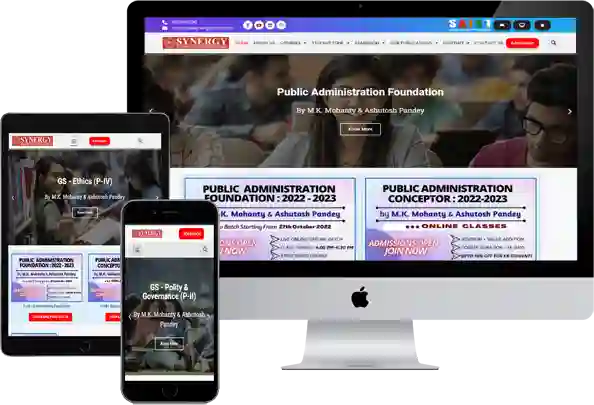
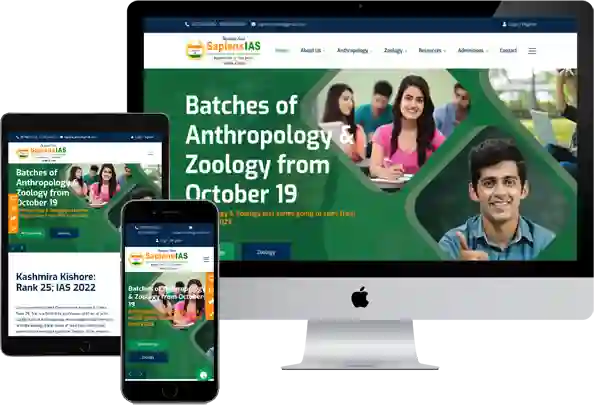
FOLLOW US ON
Facebook
Twitter
LinkedIn
Pinterest
WhatsApp
Skype
SEO Insights, Tips & Trends from Our Blog
Why Your Coaching Institute’s Website Doesn’t Show Up When a Student Asks Google’s AI
Is Your Coaching Institute Visible on AI? AI Search Visibility More Student Enquiries ChatGPT & Gemini Ready AEO

Performance Marketing for Educational Institutes: A Complete Guide to Getting More Admissions in 2026
Scale Educational Admissions Using Performance Marketing Strategies Targeted Student Lead Generation Data-Driven Campaign Optimization High-Converting Ad Creatives Multi-Channel
Lead Generation for Coaching Institutes: Complete Data-Driven Guide (SEO, Ads, AI & Student Enrollment Strategy)
Fill Your Coaching Batches with Predictable Leads Data-driven student acquisition strategy SEO, Ads & AI combined High-intent enquiries,
Indian Education Marketing Statistics Report 2026: SEO, PPC, AI, Lead Generation & ROI Trends
Indian Education Marketing Stats 2026 Every Institute Owner Must Know Real Data on Student Search Behaviour SEO, PPC
Website Design for Coaching Institutes and Education Institutes in India — The Complete Guide (2026 Edition)
Your Coaching Website is Not a Brochure — It’s Your Admission Engine Why Coaching Websites Fail to Convert
How Big is the UPSC Coaching Market in India: Official Data, Student Segments, Revenue Estimates, and Growth Trends (2026)
The Complete UPSC Coaching Market Guide for Institute Owners Real Market Numbers Most Owners Miss 6 Student Segments
Trusted and Affordable Digital Marketing Company in Delhi, India
- Latest Marketing Strategy
- Affordable Service Packages
- Improve User Experience
- Quality & Organic Traffic
- Transparent Progress Report
- Certified Professionals Expertise
Request a Quote
5/5 - (20 votes)


